Assignment israel km 027, p.1
Assignment Israel (KM 027), page 1
part #27 of Killmaster Series


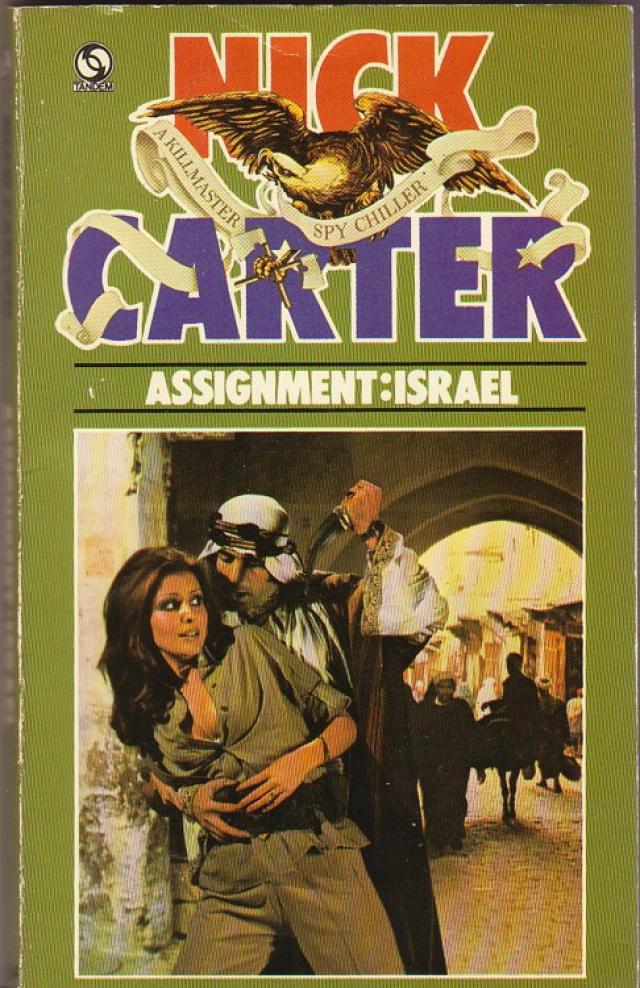
Assignment Israel (1967)
(Book 27 in the Killmaster series)
Version 0.9
Dedicated to The Men of the Secret Services of the United States of America
CHAPTER 1
NEWS ITEM: THE HAGUE, NOVEMBER 1—Communist China’s senior diplomat here left the country today under an expulsion order as Dutch police investigated the mysterious death of a minor attache at the Chinese Communist Office. Li Chiu, the charge d’affaires here, was ordered out of the country because of his lack of cooperation in the death, believed by the police to be murder, of one Hsu Tzu-tsai. Police have a theory that the dead man was caught in the act of defecting to the West… .
The Rozengracht is a quiet street near the outskirts of The Hague, Holland’s famous diplomatic city. It comes to a dead end. Near the end of the short street, set well back and guarded by high iron gates, is a brick mansion housing the Chinese Communist Office. On this particular early evening in the last week of October only a few dim lights shone in the building. It was a weekend and most of the staff were away on business or pleasure. It had gotten dark early and a light rain was falling.
A side door of the brick mansion opened quietly. A man stood for a moment in the doorway, listening and peering out into the fast falling gloom. The man stood in silence, unmoving, for five minutes. When he did move he moved fast. He darted across a narrow gravel drive and, keeping to the grassy verge, ran toward the iron gates at the end of the drive.
The gates were locked, and there was an electric warning system, but he managed to find and disconnect that. He began to climb the gates, as nimble as a monkey. A frightened monkey. He dropped the last six feet, turned to his left, and began to walk rapidly away.
There was a dark areaway across the street from the gates. From it now a voice spoke sharply in Chinese. “Hsu Tzu! Stop!”
Panic flared in the man’s heart. So it had been a trap after all! A carefully set snare. They had been waiting for him all the time. But he was not going back. Not after all his planning and waiting. He was not going back to China! He began running, running with all his might, running with the speed of a desperate man, a man with the Dragon Death on his heels. The death that was reserved for traitors.
Behind him the voice snapped again. “Stop! Stop, you son of a turtle!” There was the sound of a revolver cocking.
Another voice said: “No shooting, you fool! This is Holland. After him. We know this neighborhood and he doesn’t. We’ll get him. Watch out for the police.”
The running man, already tiring, made a fatal mistake. He turned off into a narrow lane, saw too late that it was an impasse, and had to retrace his steps. It cost him nearly all of his lead. By the time he turned another corner the two men behind him were within fifty yards.
The fleeing man knew then that he was not going to make it. He took something from his pocket and, his steps flagging now, glanced wildly about him. He could not bring himself to throw it away—not after all the tedious, painstaking work. It was too important to throw away. Terribly important. It could mean war—or no war.
He stumbled and nearly fell. His breath was rasping now and his lungs were balloons of fire. If only there were a placc to hide it—hide it where it was sure to be found.
He rounded another corner and saw a small boy. The boy was standing just outside the aura of a single dim street light. He was doing what all small boys do from time to time—he was making water in the gutter. He glanced up at the man in sudden terror, no doubt visualizing the police and parental disgrace.
The corner he had just rounded shielded the running man for three seconds. He tossed the object to the boy and, in very good Dutch, gasped: “Take it to the Americans!” He pelted on.
His two pursuers did not see the small boy. They panted after the first running man. The small boy, holding the object in one hand as he zipped his trousers with the other, stared after them. He was small, but he was almost nine, and as a citizen of The Hague and familiar with many nationalities, he recognized them as Chinese.
At that moment the boy heard a muted scream and the sounds of a scuffle from the far end of the dark street. He turned the other way and began to run. He ran around the . corner and squarely into the arms of a big policeman.
The policeman grabbed him. “Where are you going in such a hurry, you little devil?” He saw the glinting object in the boy’s hand and took it from him. “And what’s this? You’ve been stealing!”
“I didn’t steal it,” the boy wailed. “I didn’t! The man gave it to me. He said to give it to the Americans. I swear he did. Honest. I didn’t steal it.”
Keeping a firm grip on the boy’s arm, the policeman said, “What man?”
The boy was near to tears now. “The man. That’s all I know. He was Chinese. He was running away from the other two. They were Chinese, too.” Then the boy remembered. “I think they were fighting. I know it. I heard them down at the far end of the street.”
“I don’t believe you for a minute,” said the policeman, “but come on. I’ll take a look.”
With the boy firmly in tow he went to the far end of the street. It was a dead end, but a narrow lane snaked away to the right. The policeman, still holding the boy firmly, put the beam of his flashlight into the lane. He knew this lane, it was part of his beat, and knew that it went through and came out on another street. If there had been any men they would be well away by now and—
He let out a grunt as the white cone of light fell on the crumpled body of a man. Hah! The kid hadn’t been lying after all. For a moment the policeman considered. No use showing the boy a dead body, not at his tender age, still he didn’t want to lose him. He glared at the child. “I’m going in there. You stay here. Stay, do you understand? If you run away we’ll find you and send you to prison for twenty years. Do you understand me?”
By now the boy was white and shaking. He stammered, “Y-yes sir. I—I won’t run away.” He couldn’t have. His legs wouldn’t have held him up.
The policeman went into the lane and put the light on the body. He had seen enough of death to know that the man was dead, even from that first cursory glance. Now he made sure. Dead, all right. A slightly built Chinese, about thirty or so, good clothes. Not bad looking if you liked Chinese. He didn’t, particularly.
The man had been brutally beaten about the head. A dark pool of blood was already turning sticky on the cobbles. It looked as though he had simply been clubbed to death, though there might be other wounds. That was for the Medical Examiner to find out. The policeman turned away, carefully avoiding the blood—these were his best shoes—and went back to the boy.
This time he patted the boy on the shoulder. The kid was scared to death, and the policeman was not an unkind man. “At least you weren’t lying about that. Now about this.”
For the first time he put his light on the object he had been carrying. It was an old-fashioned pocket watch of the sort that was once called a “turnip.” It had a strap and a fob. A fob? The policeman examined it. It was a bullet. A heavy bullet attached to a metal strip at the end of the leather strap by some sort of fusing. Brazing? No matter. It was a strange sort of watch fob. The policeman fingered it. It felt like a steel-jacketed .45 and there was a strange roughness, a sort of burring, on the steel jacket.
The policeman looked at the boy. “Now, what did the man say again, when he gave you this?”
“Take it to the Americans.” The boy began to cry. “I want to go home.”
The big policeman put his arm around the boy’s shoulders. “Soon, my boy. Not just yet. You’d better come to the station with me first. You’ll have to talk to the Inspector.”
He flashed his light back into the lane for a moment. The crumpled body was still there. What had he expected? That it would get up and walk off?
As they went back down the street and around the corner the policeman reflected that “take it to the Americans” could mean only one thing in a city like The Hague. The American Embassy.
From the local station the watch and bullet fob went to District and then to Central Recherche, where it was turned over to a most astute Chief Inspector Vandiver. He had them examined in the lab. When he read the report he whistled softly and thought that most certainly the Americans should have them. As soon as possible.
In a very few hours the fob, the fob only, was on its way to Washington in a diplomatic pouch.
NEWS ITEM: BEIRUT, LEBANON, NOVEMBER 3—The Chinese Communists have begun a wide campaign in the Arab world to explain their “cultural Revolution” and the role of the Red Guards. Huge sums of money are being spent in this effort… .
In Peking, just inside the Imperial City and near the Temple of Heaven, there is an obscure little building. It is an old-fashioned building, with the traditional curving eaves to ward off demons. The plumbing is bad and there is no central heating. In winter the building is chill and dank. Even in this first week of November the building was not really comfortable. In a small room on the second floor it was still less comfortable.
The thin Chinese behind the desk did hot appear to mind the lack of heat. His name was Piu Chui and he was Chief of the Propaganda Services of the Central Committee. There are, of course, many different types of propaganda. Bullets and grenades are propaganda.
The big, stocky white man with a shiny bald head could have used a bit of heat. He was used to the desert. He was rather a handsome man in a brutal sort of way, or would have been handsome if he had had hair; he might have been anywh
Piu Chui was not a man to waste words. He did not so much as glance at the fat interpreter as he spoke. Instead he kept his gaze on the powerfully built bald-headed man.
Piu Chui had a formal manner of speech. “We are, Mr. Lucy, most interested in fomenting a war in the Middle East if it can be done without involving ourselves. That must be distinctly understood. I approve of your plan to start such a war, and we are prepared to finance you heavily. Using propaganda funds, of course. It is a good plan. You appear to know your business. You were, I believe, with Rommel?”
Mr. Lucy nodded at the interpreter after he had heard this. “Tell him that I was with Rommel for a time. I am a desert specialist. I was known as the German T. E. Lawrence.” The odd thing about this was that Mr. Lucy spoke in an almost perfect upper-class British accent. This accent was a very important part of his cover, one of several things that had so far managed to protect him from the gallows or a firing squad. For years now Mr. Lucy had been living in the shadow of both, dependent largely on who caught him first—the Russsians or the Jews.
Piu Chui stared at the big man. “We have not much interest in Israel, of course, one way or the other. It is too small a nation and too remote to concern us. We do not particularly care if Israel lives or dies. But we can use a diversion on that side of the world just now. Now, please, let me have the details of your plan again. Most minutely, please.”
When he heard this a dour smile flitted over the big man’s lips. He certainly cared about Israel. If they caught him he was sure to be hanged, just as Eichmann had been. If Israel could be wiped off the map it would mean an increase in his personal safety by at least half.
Mr. Lucy and Piu Chui conversed for another half hour. As the bald man prepared to leave, Piu Chui said: “I have arranged for your transportation as far as possible. After that, of course, you will be on your own. And the funds we spoke of will be forthcoming at once.”
Mr. Lucy nodded at the interpreter. “Tell him that I have made arrangements also. I will be in Syria in three days. And it is most important that there be no delay about the money. I have much to do—many arrangements to make and many expenses.”
Mr. Lucy walked toward the door. Seen upright and in motion there was something bear-like about him. An impression of enormous physical strength. The impression was not misleading. Mr. Lucy had killed many men with his hands—and enjoyed doing it.
As he reached the door Piu Chui spoke behind him. He spoke in near perfect English, though it amused him, at times, to pretend he neither spoke nor understood the language.
“Goodbye, Herr Gerhardt. I hope your plan is successful.”
The bald-headed man turned to stare back at the desk. Though he did not show it, internally he was a little shaken at hearing his true name spoken aloud. It had been so long.
“Your people have good files,” he said.
Piu Chui smiled thinly. “We manage,” he said.
On the plane going south that night Mr. Lucy— privately he liked to think of the name as a diminutive for Lucifer—was still a bit shaken. He had taken such pains, gone to such lengths, to cover himself. He had lost a lot of weight in Argentina and kept it down. By chemical means he had killed his thick blond hair and gone shiny bald. He rubbed his pate now. That had hurt. He had also had a face job done—he couldn’t complain about that, because it had actually improved his features. He had perfected his British accent. His command of the various Arabic dialects was already superb.
Mr. Lucy put a finger into his mouth and fingered a back molar. He had even had a tooth drilled out, a perfectly sound tooth, and installed a tiny pellet of cyanide. Just in case. Then the tooth had been covered with an easily removable cap.
Just the same it was disturbing that someone, Chinese Intelligence, knew Gunter Gerhardt, the infamous GG, in his present guise. He did not like it at all. He had been only a block away when the Jews had taken his good friend Eichmann. He still broke out in a cold sweat when he thought about it, and he was not a man who frightened easily.
Then Mr. Lucy, Mr. William Lucy—he had even taught himself not to think in German, nor of Gunter Gerhardt—shrugged his powerful shoulders. Nothing to worry about. The Chinese would not betray him. Unless, possibly if he failed in this job, or for some other reason that particularly suited their interests. He could not imagine this contingency.
He was not going to fail. He was a professional and he knew his job—professional troublemaker in the international field. Mr. Lucy put his head on his chest and went to sleep. He would be in Syria in three days and there was much to do.
NEWS ITEM: DAMASCUS, SYRIA, NOVEMBER 8—HFR, the Heroes For Repatriation, today assailed King Hussein of Jordan in a statement that reported a raid on the Israeli town of Beit Jibrin. The commandos, believed to be mostly of Syrian origin, claimed to have raided across the border into Israel, destroyed half the town, and blown up an Israeli ammunition dump with more than a hundred pounds of high explosive. They also claim to have taken prisoners. They then retreated back across the border to avoid conflict with nearby Jordanian forces.
The HFR have been attacking Hussein of late on the grounds that he tries to suppress commando activity against Israel and that he works closely with the United States Central Intelligence Agency in protecting “the security of Israel …”
The big bald-headed man was in Syrian uniform now. He wore no insignia of rank. The man who sat beside him in the jeep was a Syrian Colonel, but there was no question as to who was in command. Nearby, on picket duty, were a few heavily-armed Syrian soldiers, also in uniform. The raiding party had worn nondescript clothing and carried no identification.
The jeep was parked in the mouth of a wadi, from where the two men could see a quarter of a mile across the border into Israel. The raid had been staged just at dusk, which had now deepened into darkness. They could see the lurid stain of fire on the night, and the vicious hanging crump of grenades and the rattle of small arms fire came clearly on the night wind.
The Syrian Colonel said: “Those Israeli bastards are putting up a hell of a fight, General Lucy.” The Colonel did not know just what sort of a general Lucy was—he never wore insignia—but he had been told, by the highest sources in Damascus, to take orders from this man. The Colonel did not like General Lucy very much—there was a coarseness about the man, a powerful beefiness, a coldness, that offended the slim, somewhat effeminate Colonel. Still, orders were orders. Damascus must know what they were doing.
The big man beside him was chewing on a thick cigar. He took it from his mouth and spat. “Yes,” he agreed. “They fight now.”
He should know, he thought, that they had not always fought. He had sent enough of them to the gas chambers, or the gallows, or had them mown down with machine gunfire. Always on his written order, always with his signature at the bottom, scrawled in a flourishing GG. Always in red ink. A nice touch, that had been. The big man sighed. Those had been the days, no doubt of it. Condemned—by order of GG. Gunter Gerhardt. Jews and Russians. Communists. Given his choice, General Lucy thought now, he had always preferred killing Russians to Jews. The Russians had always been fighters, hence the more pleasure in killing them. But now the Jews had turned into fighters also, damned fine fighters—he would give them that—and so all the more pleasure in killing them. Not that he really cared, these days. He, Gunter—no, damn it, General William Lucy— he was a man without a country. A professional adventurer and troublemaker. And he was getting a little old. All he really cared about now was making as much money as he could and protecting his own neck. One day he would find a safe spot and settle down and find himself a woman and…
A soldier, speaking to the Colonel, broke his line of thought.
“They’re coming back, sir.”
“Good,” said the Colonel. “I hope they took some prisoners. Those were the orders.”
The big man took off his officer’s cap and scratched his shining head. “My orders, Colonel. Not from Damascus. I want the prisoners for a certain purpose of my own.”