

Displaced, p.1
Displaced, page 1


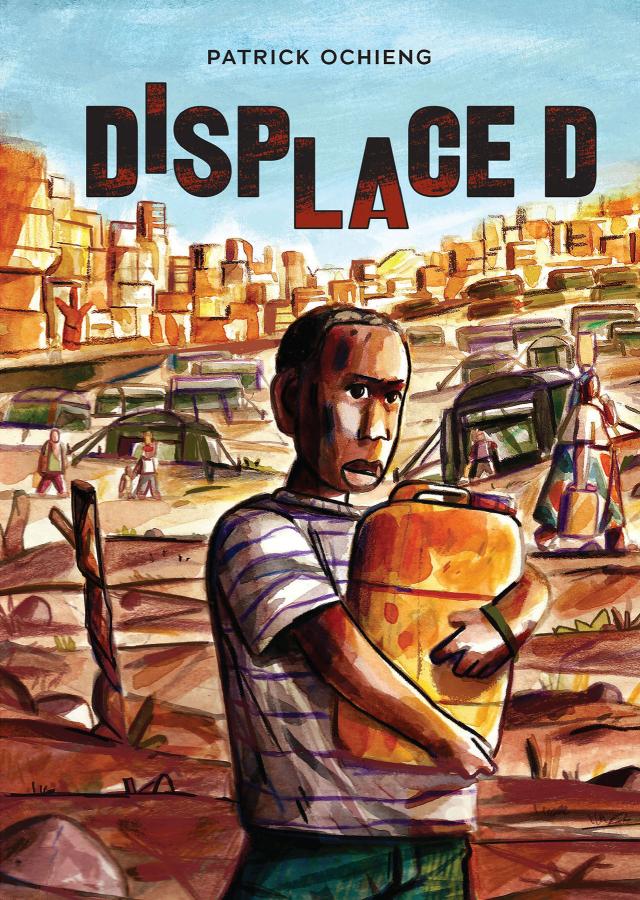
Text copyright © 2025 by Patrick Ochieng
All rights reserved. International copyright secured. No part of this book may be reproduced, stored in a retrieval system, or transmitted in any form or by any means—electronic, mechanical, photocopying, recording, or otherwise—without the prior written permission of Lerner Publishing Group, Inc., except for the inclusion of brief quotations in an acknowledged review.
Carolrhoda Books®
An imprint of Lerner Publishing Group, Inc.
241 First Avenue North
Minneapolis, MN 55401 USA
For reading levels and more information, look up this title at www.lernerbooks.com.
Cover illustration by Moera.
Background image: Jackyenjoyphotography/Getty Images.
Main body text set in Bembo Std.
Typeface provided by Monotype Typography.
Library of Congress Cataloging-in-Publication Data
Names: Ochieng, Patrick, author.
Title: Displaced / Patrick Ochieng.
Description: Minneapolis : Carolrhoda Books, 2025. | Audience term: Preteens | Audience term: Teenagers | Audience: Ages 10–14. | Audience: Grades 4–6. | Summary: After fleeing their home in Kenya due to post-election violence, fourteen-year-old Kim and his family stay in a camp for displaced persons where Kim and his new friends fight to improve the water supply for everyone.
Identifiers: LCCN 2024045662 (print) | LCCN 2024045663 (ebook) | ISBN 9798765648698 | ISBN 9798765673447 (epub)
Subjects: CYAC: Refugees—Fiction. | Refugee camps—Fiction. | Water supply—Fiction. | Kenya—Fiction. | LCGFT: Novels.
Classification: LCC PZ7.1.O1985 Di 2025 (print) | LCC PZ7.1.O1985 (ebook) | DDC [Fic]—dc23
LC record available at https://lccn.loc.gov/2024045662
LC ebook record available at https://lccn.loc.gov/2024045663
Manufactured in Guang Dong, China by Dream Colour Printing
1-1011931-53421-12/19/2024
To Ian and Jairus. May your trust and friendship be guided by factors other than ethnicity and race.
Prologue
My teeth chatter. My hands tremble. My heart throbs. Rain lashes at my face. I go down on my haunches and lock my fingers in Papa’s trembling hand. His body is sprawled in the mud. He pulls me close, whispers in my ear, “Go! Kimathi. Get back into the house!” His fingers slide away from mine, or maybe it’s me who slips away. A flash of lightning streaks out, revealing Rono’s body lying close to Papa.
Ma appears in the doorway. She clamps her hands to her head. Her mouth twists in a grimace, a suppressed scream. She runs back into the house and emerges with my five-year-old sister, Ngina. “We have to leave! Now!” she shouts and hoists Ngina onto her hip. With her free hand she hikes up her dress. “Run, Kimathi, run!”
So we are running. Running out of our compound. Running through mud. Running uphill. Fleeing from our home.
Panting.
Out of breath.
We run.
The rain pelts down. Mud squishes and slurps at our heels. We stop at the top of the incline that overlooks our house. A small blob of orange floats in the air and blossoms into a huge flame on the roof.
“Why?” I cry.
“Don’t look back, Kimathi, just run!” Ma calls out, clutching Ngina, as the sounds of footfalls and voices draw near.
We continue running. Tripping. Falling and rising to run even faster.
A voice calls out from the shadows: “In here! Come in here!” It can only be Gogo, the old woman who lives by the roadside in a tiny wooden shack.
We duck in and huddle next to her.
“Shh!” she hisses as the voices draw near. “You’re safe here for now.”
Chapter 1
I could start with when Rono banged on my bedroom window and screamed. Or a few minutes before that, when Ma ordered me to my bedroom and Papa, seeing my reluctance, shot me a stern look that sent me to bed. But no! I have to start with the time I first met Rono, who became a good friend—almost a brother.
I was nine then. It must’ve been a weekend or during the holidays, as I wasn’t in school. I looked out through the kitchen window and there was this stranger standing by our kai apple fence. He was tall with wide shoulders and had a boyish look.
“Are you looking for someone? Can we help you?” I remember Papa asking, and at first the stranger didn’t answer. When he finally did, he spoke with a stutter.
His name was Rono, he said. He was looking for work. Any kind of work.
Papa then asked him lots of questions. Rono’s answers almost drove Ma to tears.
He said he thought he was seventeen but wasn’t too sure, and he had no ID. He’d dropped out of school to take care of his sick mother, he added in a resigned tone. He had no other family, he said.
After that Papa stopped asking him about himself. He let Rono sit in front of our house, under the mango tree. Ma served him a mug of porridge and sweet potatoes, which he stuffed into his mouth like he hadn’t eaten for days. Papa suggested that Rono pass by the following week, when he might need a hand with some repairs to the roof.
But the next morning Rono was back already. And the following day, and the day after that. Soon he was all over the place, helping fix one thing or another. It wasn’t long before Rono was doing odd jobs for our neighbors too.
Every time Rono greeted me, his hands swallowed mine. He walked with a limp and was slow with his words, as though he were scared of saying or doing the wrong thing and wanted to be sure. He would run his tongue against his lips for a few seconds trying to make sense of whatever he had been asked to do. Once he got it, his face would light up. He would then lower his head and work at it until it was done.
When my parents had no work for him, he helped on the nearby farms. He could easily lift a full sack of maize and stack it onto a high pile. But he was also gentle and patient when kids trotted behind him, even when they aped his limp and mimicked his stutter. He would invite them for piggyback rides on his wide shoulders. Soon enough they would be whooping with joy as they took turns on Rono’s back.
It was Rono who taught me to ride a bicycle. He would hustle along beside me as I pumped the pedals of Papa’s black Atlas bike, swaying from side to side. Every now and then he’d reach out to right my balance. Soon enough I was speeding around, with my hands off the handlebars and Rono gleefully clapping.
In turn I tried to teach Rono how to play chess, which I’d recently learned at school. I told him the pawns were servants and the knights were soldiers, protecting the queen and king. But when I showed him how far and fast the pieces could move on the board, he shook his head doubtfully. “How can a queen move faster and farther than servants and soldiers?” he wanted to know. “Those are stronger than the queen. Unless you meant that they’re carrying the queen on their shoulders.”
Rono decided he preferred checkers.
…
“Today I have to run an errand near my house,” Rono told me one afternoon. “If you want to come with me, I’ll show you where I live.”
He’d been helping out for a couple of months now and I had never stopped asking him to take me to his house. But it was in the Jijenge slum in the center of Eldoret, a great distance from the suburb where we lived, and Papa had warned against going there. He said it was a dangerous place.
That day, though, Ma and Papa were away, attending the funeral service of one of Papa’s coworkers, so I was free to go wherever I wanted.
My legs worked hard to keep up with Rono’s pace. We walked for a long time before turning off the paved road and onto a dirt path. Squeezing between zinc and tin shacks built close together, we leaped over a couple of sewers and hurried past lots of garbage before stopping by a rusted shack. Smiling, Rono dug his hand into the pocket of his overalls, brought out a key to open the door.
The floor inside the shack was earthen. The inner walls were covered with old newspapers. It was dark and dank.
“Why do you live in a place like this?” I asked. “Why can’t you come and live with us?”
Rono didn’t answer. His lips just twisted into a sad smile.
For days after that, I wondered how anyone could spend even one night in that creepy place with only a flattened, tattered foam mattress in a corner. How anyone could still smile and whistle out a merry tune the next morning. Me, I would be mad at everyone and everything if I had to live there. But not Rono. I never even saw him act annoyed.
I thought of telling Papa about Rono’s shack—of asking him why Rono couldn’t live with us, especially since we had an extra room no one used. But asking would’ve meant coming clean—admitting that I had disobeyed Papa, that I had visited the Jijenge slum. Papa would be cross with Rono if he found out Rono had taken me there. No, I wouldn’t tell Papa. I would keep the secret to myself.
…
Papa often said Eldoret was a melting pot. “That’s a place where lots of different people from different places have come together to live or carry out their business,” he explained. Though he himself had been born in Eldoret, his own father, like many others, had migrated from central Kenya.
Ma had been born in central Kenya at the foot of Mount Kenya, which she said had a lot of history. She liked to tell us how Queen Elizabeth of England first heard that her father had died and discovered she was the new queen while she was visiting a place called Tree Tops in Nyeri, near where Ma was born.
Like Papa, my little sister, Ngina, and I were born in Eldoret, which is in the Rift Valley, a place famous for producing world -class athletes.
Papa named me Kimathi after the Mau Mau freedom fighter Dedan Kimathi. “You must never forget your roots,” he would say. Then he’d go on and on about how Dedan Kimathi and his brave fighters hid in the forests as they battled the colonizers.
By the time I was thirteen, I was going to Central Secondary School, which stood in the path of most flights to the airport. “There we go again,” my history teacher would say with a scrunched face each time a plane flew past, disrupting his lesson. This had earned him the name Scrunchy. But call him that within his earshot and you would be hearing more from him.
Nothing exciting happened in our suburb of Eldoret. Life was so quiet that when Scrunchy was locked in the trunk of his Toyota by carjackers, everyone talked about it for weeks.
Then the general election was held the year I turned fourteen. And the presidential election results were announced. And our lives were turned upside down.
Chapter 2
On the Sunday before the election, we attended mass at St Augustine’s as we always did. Papa settled us on the second-row pew like he always did but barely said a word. Ma too was silent. Even the elderly woman who always wore wide-brimmed hats that you had to duck under didn’t fuss over Ngina like she usually did.
“It is your neighbor whom you first run to when you are in trouble,” Father Otuoma said in his homily as he adjusted the sleeves of his cassock. “That neighbor will probably not be your brother or your relative or even a member of your ethnic community. Yet he will be the one to help.”
I wondered if Father Otuoma knew about the leaflets someone had dumped at our gate a few weeks earlier. Printed in bold letters were the words GO BACK TO WHERE YOU CAME FROM. Under the words was a picture of a machete.
For once Papa didn’t doze off during the homily. I couldn’t say the same for Ngina, who snored all through Mass.
The next day, Ma and Papa left early to vote at the nearby Bitok primary school. They were back by noon, their left pinky fingers dyed purple—proof they had voted. And then the long wait for the results began.
Four days on, the results were yet to be finalized.
On TV, a woman in a red dress and an exhausted-looking man went on and on. “These are only provisional results,” the woman kept saying, like she needed to assure everyone that whoever they supported still had a chance.
Ma kept walking in and out of the kitchen, checking on our supper, while Papa sat on the edge of his favorite blue sofa in our living room, biting his nails. Ngina was dozing next to him.
“It’s going to be a close race,” Papa kept repeating.
After supper, Ma said, “It’s time you went to bed.” But my eyes remained glued to the TV. By now, the screen flashed scenes of people rioting. Scenes of car tires burning on roads. People smashing the windows of cars and buildings, looting shops. The police dispersing them with tear gas.
“You heard what your mother said.” Papa gave me his no-nonsense look and I quickly ducked into my room, but I could still hear Ma and Papa’s conversation through the open door.
“I don’t like the way things are going,” I heard Papa tell Ma. “We should’ve moved to the city for a while like you had suggested.”
“It’s too late now. If we were going to move it should’ve been right after those leaflets started appearing.”
“We’ll be okay,” I heard Papa say.
I must have fallen asleep. Then suddenly I was woken up by someone banging on my bedroom window and shouting, “You must leave! They’re coming for you! You must leave!”
I sat up and rubbed the sleep from my eyes. And I could tell it was Rono. Without a thought I shot out into the rain.
How was I to know that Papa would follow? Or that there would be men with machetes waiting outside?
Chapter 3
We’ve been at the Eldoret police station for two days now. We’re not the only ones here. Two other families who arrived before us are in what I’ve heard the police call the Exhibit Room, which is no more than a dark storage space. Then there’s the man with a huge, stained bandage wrapped around his forehead. He keeps shaking his head and muttering to himself. There’s also a gray-haired man and a girl who could be his daughter, hovering at the entrance of the station next to the stairs. Two more families are with us in the main hall.
I wonder if these are the only survivors from our neighborhood.
I watch Ma bite her lower lip as she stares at the station’s gray walls. Earlier today, I heard the balding police officer whisper to Ma that the Mosetis, our nearest neighbors, didn’t make it out. I didn’t have the heart to ask if that meant my friend Makori and his sister Moraa . . . I can’t even bring myself to say the words. Those two are my classmates at Central Secondary School. Or should I say were my classmates?
“Did Papa feel pain?” Ngina asks.
“It’s all right.” I pull her close. “Papa is in a better place.” I repeat what the priest said at Grandpa’s funeral.
“I want to go home,” she says.
“I know. But we have to wait until it’s safe.” Ma’s been trying to get in touch with her sister in Nairobi, to see if we can come stay with her, but in the meantime we’re stuck.
“Where will we live, now that those people burned our house?”
“We can build another house.”
“But what if those people come back?”
“We’ll only go back after we’re sure they’ll leave us alone.”
“Is Rono in heaven with Papa?” Ngina fires on.
Ma shoots to her feet. “Now that’s enough. I’ll not have any more of that talk. Things are already bad without you reminding everyone about it. Do you hear me?” Ma blinks back her tears.
After that, we don’t speak about Papa or Rono.
Chapter 4
Normally a two-hour drive, the journey from Eldoret to Nakuru takes us a whole day. Our convoy of over a dozen police trucks snakes its way through the rock-littered road. Every so often, a half dozen or so police officers with rifles stand guard as others remove boulders, logs, and burnt shells of cars that block the road. All around are burnt houses, still smoldering. Though no one mentions it, we sense that we’re being watched from the wooded hills on both sides of the road. The sun is sinking behind the green-topped hills when our convoy crawls into the compound of the police station in Nakuru.
The station’s dusty compound is crowded with men, women, and children who have sought refuge from different parts of the country. Some have limbs suspended in makeshift slings. Others have bloodstained clothes. They huddle in groups and speak in low tones. It doesn’t take long to realize they’ve separated themselves according to ethnicity. Together with two dozen or so other families, we’re fortunate to find some space inside the station cafeteria.
…
For a whole week now, Ngina, Ma, and I have jealously guarded our space on the crowded, cold floor of the cafeteria. Add that to the two nights we spent on a bench at the police station in Eldoret, and you’ll have an idea of what we’ve been through. Yet I keep reminding myself that we’re the fortunate ones to have escaped with our lives. Others were not so lucky.
Since we arrived in Nakuru I’ve had a recurring nightmare. It always starts with Papa’s fingers enclosed around mine. Sometimes he says, “Go, Kimathi. Get as far away from this place as possible,” and then I’m running. Falling. Rising to run again.
Other times Papa pleads, “Don’t leave me, Kimathi!” as I pull away from his cold hand and then my feet are pumping, fighting to put distance between us. As I flee, the rain slaps at my face and the wind howls at my back, with Papa’s screams growing louder.
I’m having one of those nightmares when I start awake, my body drenched in sweat. A queasy feeling hits me and my head spins as I stare at the bodies curled up on the police station’s cafeteria floor. Slowly, the tension leaves and my breathing calms. That’s when I hear the scuffing of feet against the cement floor.
“Who is it?” I pull out my penknife from my pocket.
“I just want to talk,” a voice whispers from the dark.
“I’ve got a knife and I’ll use it.” I fix my eyes on the shadowy figure, crouched on the floor. A boy, probably my age.






