Solimeos, p.1
Solimeos, page 1


Praise for Solimeos and Rhoda Lerman
“Solimeos is an astonishing novel of epic sweep in which The Third Reich is reborn in the forests of the Amazon—singular in its exquisitely detailed, bold re-imagining of the aftermath of the darkest chapter in twentieth century history. The most astonishing and original book I’ve read in years, this tale of adventure and intrigue is as horrifying and shocking as it is sublime and beautiful.”
–Jay Neugeboren, author of The Stolen Jew
“Lerman’s is a unique voice—wildly funny, achingly spiritual, profoundly Jewish and feminist at the same time.”
–The New York Times Book Review
“The very opposite of a minimalist, Lerman proves herself mistress not only of side-splitting one-liners but also of pregnant perception about faith and virtue.”
–Publishers Weekly
“Reality is canted through Lerman’s slyly irreverent sensibility, one of the most idiosyncratic in contemporary prose.”
–Village Voice
Also by Rhoda Lerman
Call Me Ishtar
The Girl That He Marries
Eleanor
The Book of the Night
God’s Ear
Animal Acts
In the Company of Newfies
Elsa Was Born a Dog, I Was Born a Human... Things Have Changed
A WICKED SON BOOK
An Imprint of Post Hill Press
ISBN: 978-1-63758-763-8
ISBN (eBook): 978-1-63758-764-5
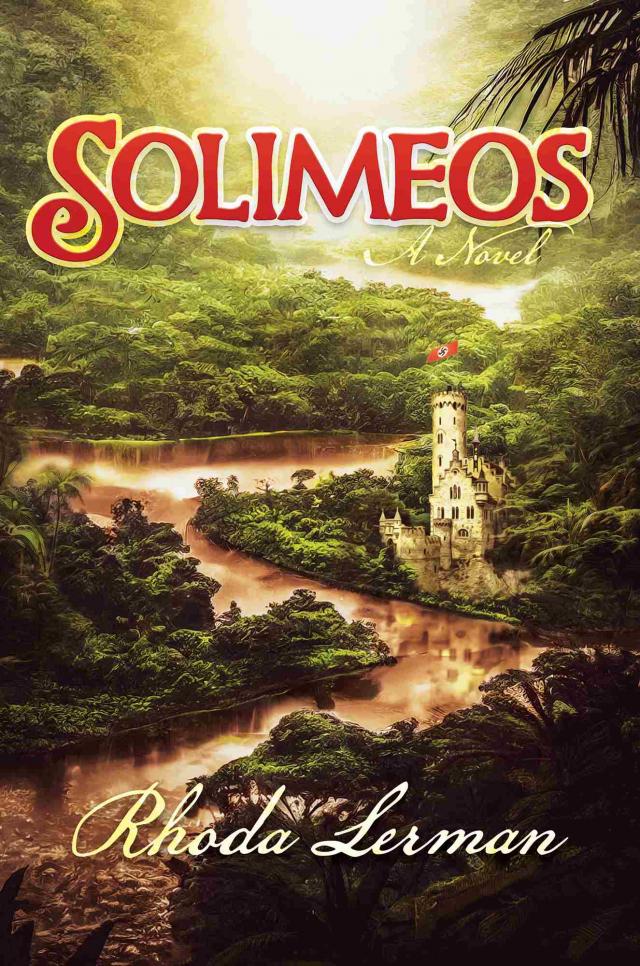
Solimeos
© 2023 by Rhoda Lerman
All Rights Reserved
Cover Design by Cody Corcoran
Interior Design by Yoni Limor
This book is a work of historical fiction. All incidents, dialogue, and characters aside from the actual historical figures are products of the author’s imagination. While they are based around real people, any incidents or dialogue involving the historical figures are fictional and are not intended to depict actual events or commentary. In all other respects, any resemblance to actual persons, living or dead, events, or locales is purely coincidental.
No part of this book may be reproduced, stored in a retrieval system, or transmitted by any means without the written permission of the author and publisher.
Post Hill Press
New York • Nashville
WickedSonBooks.com
Published in the United States of America
Contents
Prologue
Chapter One
Chapter Two
Chapter Three
Chapter Four
Chapter Five
Chapter Six
Chapter Seven
Chapter Eight
Chapter Nine
Chapter Ten
Chapter Eleven
Chapter Twelve
Chapter Thirteen
Chapter Fourteen
Chapter Fifteen
Chapter Sixteen
Chapter Seventeen
Chapter Eighteen
Chapter Nineteen
Chapter Twenty
Chapter Twenty-One
Chapter Twenty-Two
Chapter Twenty-Three
Chapter Twenty-Four
Chapter Twenty-Five
Chapter Twenty-Six
Chapter Twenty-Seven
Chapter Twenty-Eight
Chapter Twenty-Nine
Chapter Thirty
Chapter Thirty-One
Chapter Thirty-Two
Chapter Thirty-Three
Chapter Thirty-Four
Acknowledgments
To my husband Bob
And the whole earth was of one language, and of one speech.
Genesis 11:1 (KJV)
Prologue
My father stood on the parade grounds between the castle and our home, between the past and present. The only animal we hadn’t eaten was his beloved giraffe, Violet. Papa gazed up at the fortress and sighed. “Where will it sink to sleep and rest, this murderous hatred, this fury?” Then he turned to me. “Who wrote that, Axel? Do you know?”
I was fourteen and half his size. Of course I didn’t know.
The Pappendorf castle, our castle, built on the ancient foundations of a Knights Templar fortress, loomed above our house, sinister, archaic, toothless, collapsing into the dark arms of the Black Forest. A fortress, a stronghold that was no longer strong; it was our history. Its shadow crept over us, blocking our house from the sun until noon. In winter storms, criminal winds blew through the castle’s windows and turrets, shrieking a terrible symphony. Sometimes a stone crashed into the silences of our forest, a crumbling block of wall shattered the night. From the weapon windows, shafts of musky sunlight, quivering with their ashes of stone and death, drew stripes on the stretch of pavement that lay between our house and the castle. This pavement had once been the parade ground for the Pappendorf armies.
Our house, a turreted, buttressed solidity, itself built by my grandfather from Templar rubble, was a few hundred feet distant from the castle. Where once banners and flags fluttered in the forest winds, now a rope line fluttered with diapers and bed linens.
To our left, on the shoulder of our mountain, my great-grandfather had built foundries with stones from the Templars’ great stables. For the last generations of Pappendorfs, these foundries had belched black smoke into the forest and fortunes into our pockets. Below the foundries in the valley was a chocolate factory. Now abandoned, but before the war its sweet smells had wafted through the windows of our house into my childhood. A railroad ran along the valley to the chocolate factory, then up our mountain, stopping at the gates of our foundries. Sprightly birches followed the railbed to the forest but stopped, dismayed by a wall of dark firs made darker by the smoke of the foundries, which, up until the last few months, had burned day and night. No longer.
The Baron von Pappendorf, my father, Dietrich, beaten and despairing, carried a rifle. I had always imagined him in another time, handsome on a great horse, wearing the suit of armor that now lies rusted and crushed in the castle, slashing at his enemies with the sword that hung over his bed. I had never imagined him like this.
Papa said, “I don’t know when or how, but we must leave all this.”
“Where will we be going?”
“I have no idea.”
Chapter One
Back when the war first thrust itself upon us, it didn’t seem real. I was eleven, but a very young eleven. I would hear adults speaking in hushed voices about my father having to leave for war. They said Uncle Wolf would take over the factory and we would have to be frugal. All I knew was that Papa and Uncle Wolf now wore handsome uniforms to the factory and carried pistols. With my father’s binoculars, Mama watched the skies above Pappendorf Castle, praying the war would end quickly. But for the bored boy that I was, it spoke of a distant excitement; nothing seemed imminent.
Occasionally a visitor with medals and ribbons would arrive and leave after long private conversations in the library. Trains screamed as they strained up the steep rails to our factories while trucks rumbled down the roads. The older son of Volker the barn man left to join the war, at which time Papa presented him with a watch. I complained that it wasn’t fair. I invariably complained things weren’t fair. When I moaned about an injustice of one sort or the other to my mother, Mama would respond, “Life isn’t fair.”
It wasn’t fair that I did not receive a watch. Just because I was too young to go to war. And on and on. Papa gave me a watch that had been his great grandfather’s. It had a sapphire, and Roman numerals in gold. It was magnificent and didn’t yet fit the bones of my wrist.
“It will fit. In time. You must eat well and eat your vegetables, and your bones will grow. And your member will be like mine. In time. Everything in time, Axel.”
Shteinberg the cook grumbled more than ever. Mama cried, snapped at us all, and carried on about shortages. Papa scolded them both, assuring them the war would soon be over as we were winning everything: Austria, Poland, Czechoslovakia. No one could stop us. Even so, Shteinberg—who had worked when she was young as a nanny in New York City—taught me English in case we didn’t win.
We were safe and ignorant. My mother thought it was perfectly stupid to learn English. If anyone could beat us, she insisted, it would be the Russians, and we certainly wouldn’t have time to argue with them before they slit our throats.
I may have been ignorant, but I was overwhelmingly curious. One night I lay in my bed, the featherbed pulled tightly around my neck. I wore Mama’s white fox coat and my winter boots under the cloud of puff and warmth.
Papa entered my room and sat on the edge of the bed. He wore his uniform and a great coat of thick black wool and gold buttons embossed with eagles and the SS runes of lightning strikes on his arm.
“Why are you wearing your uniform, Papa? Are you going to the war? Will you be a pilot again?”
“No. I’m here for a while. I’m going out tonight because a train arrives.”
“Can I go with you?”
“Absolutely not. You are never to go near the factory. You know it is forbidden.”
I was accustomed to hearing the trains’ screeches as they approached our lands, grinding lower as they arrived at the factory. When a train was arriving, Papa always put on his uniform and drove to the fa ctory. I would hear men shouting, people screaming, then gunshots, followed by a terrible quiet. Papa explained to me it was just workers arriving from the city to make more steel and they had very bad manners.
I didn’t believe him. Why at night? Why gunshots?
He smiled, never answering such questions. Mama rolled her eyes, shook her head, muttered, “This is not our business,” each time. Finally, that night after he visited me in my bedroom, I too went to meet the train.
Perspiring in my mother’s fur coat, I heard the engine of Papa’s car, threw off my featherbed, and climbed from the bed, tip-toeing downstairs and out of the house. All the lights were out. Against the windows, snow was blowing in fistfuls. Outside, I made my way to the barn, where I harnessed goats to my goat cart.
The road was bare, the forest deep in snow, the wind playing the trees in a terrible orchestration of cracking and groaning. Wolves sang in the forest around me, and Papa’s bellowing hounds answered. The light in the snow-tipped forest was cold and pink. Billows of dark smoke hung and swelled over the factories. Trucks loaded with ore shifted gears as they climbed the mountain. In the white of Mama’s coat, in the white of the snow, I was almost invisible. In my pajamas and the fur coat, riding the two-wheeled goat cart down the road, I felt strangely powerful.
I pulled the goats into the dark under the trees. Pink smoke, meat roasting, the pine trees, Papa’s factory. A train arrived, its long shrieks slicing the night. Then came the cries of people as they poured from the trains, looking into the searchlights, rubbing their eyes, stunned.
Two SS troopers with upright bayonets stood in front of the growing crowd. Troopers pulled men from women, children from parents. In the yard of the factory, I saw my uncle Wolf marking a clipboard. He counted workers one by one as they were pulled from the train. Many wore nice hats. Searchlights flashed on gold teeth, illuminated them, eyeglasses, wedding rings, the extraordinary bone, satin, rubber undergarments of women.
A frantic woman shouted, “Wait by the gate, girls. Don’t let them touch you!”
Uncle Wolf whistled Viennese waltzes with a clipboard and a whip. Weeping women were undressing. A pile of clothing, of coats, hats. Women naked, men naked, children naked, freezing. Snow on the ground. Two soldiers jumped from the train, stuck corsets on the points of the bayonets, and, as if they carried flags, paraded around in goosesteps. Other soldiers laughed. Uncle Wolf snapped a whip at them and their foolishness. They shook the corsets from their bayonets, dropped them into the pile. A soldier wrenched an infant from a woman, tossed it into the snow near me. It howled.
I crept toward the baby, wanting to lift it into the warmth of my mother’s coat. A soldier loomed over me, grabbed me by the neck, and shoved me into the crowd of naked children. Two beautiful girls with black hair down to their waists, with masses of black hair between their legs, hit me, beat me to the ground, ripped off my coat and at my pajamas. I’d never seen nakedness before. Never. On anyone. I was terrified. I yelled, “Papa! Papa!” But everyone was yelling “Papa! Mama!”
My father’s long black car roared up, into the crowd. Papa stepped out. All the soldiers froze, saluted him.
“Wait for me. Wait at the gate. Wait!” The mother’s screams grew into one continuous scream, the scream of a pig as Volker slit its throat. The scream filled me.
I yelled, “Papa. It’s me, Axel!” I broke loose.
A trooper shot at me as I came near my father. A man fell next to me, clutching his forehead. His face was red as blood. I fell at Papa’s knees.
“What are you doing here? You are never to come here.” He raised his hand and slapped me across the face. “Stupid. You endanger yourself.” My face burned and pounded with pain, shame, fear, and the mothers’ screams. At last, he threw me into the arms of a massive trooper, who wrapped me in a rough blanket and carried me to Papa’s car. Over the trooper’s shoulder I saw one of the dark-haired girls who had hit me covering her sister with my mother’s coat.
My father also saw the girl in Mama’s coat. He returned to the crowd of children. They fell back except the girl. She stood frozen, a rabbit swallowed by my mother’s white fox fur. I saw the intensity in Papa’s eyes as he looked at her, lifted her up, and carried her into the factory.
“Luba!” her sister cried out.
“Dorie! Help!”
Through the window of Papa’s car, I watched as a soldier smashed my goat cart and let our goats loose in the woods. A mother, many mothers, screamed, “Wait at the gate!”
By next morning, my goats had found their way back to the barn. And I followed Shteinberg so closely she finally swung around and snapped at me, “What? What do you want?”
I wanted to know if I’d had a bad dream. I wanted to hide in her skirts. I wanted her to soothe my wounds. Instead, I asked her why my mother hated the factory.
A silken screen slid over her face. She was behind it, no longer there. “Oh, people have to work hard there. She feels sorry for them.” It had to be a lie.
“Why do they have to work so hard?” I shivered with the cold and the memory of fear I had experienced the previous night.
She shrugged and mumbled into her soup pot. “War is hard work, Axel. Some fight. Some work. For the war. All hard. All sad,” was the most she would offer me. “Now, go. I also work.”
Lies. I took her hand and laid it on my hot and swollen cheeks, where Papa had struck me. She drew a sharp breath, shook her head, cleared her worktable, and pressed dishrags soaked in cold water against the swelling. Tears ran down her face. “You went there, didn’t you? So that’s why the Baron was so upset at breakfast. He told you not to. You don’t know that other people might be smarter than you. Especially your father. Don’t take chances, Young Baron.”
Hanging on the walls of the great room were dour portraits of kings and emperors, of Papa’s forefathers with piercing blue eyes and flamboyant walrus mustaches. In this central hall, Mama, as she often did, sat by a weak fire and quilted boiled wool vests, red and hideously ugly.
Many months after that terrifying night at the factory, Papa was leaving. Earlier, in my bedroom, holding me by my thin shoulders, he had told me not to worry. “I am not going away to fight or fly planes, Axel. I am going to learn.”
Now, as I often did, I hid and spied from the heavy, dark mahogany silences: the great fireplace, the deep window seats, the shutters. After my stern Norwegian tutor had fled because of the war, there, in the alcove of the window seat facing the forest, I read volume after volume from our library, some forbidden. I’d already studied English, French, and Latin, but now I sought out books in other languages, decoding and translating their contents.
Shteinberg gave my mother a cup of steaming tea and shuffled back to the kitchen.
In our house, which was almost two hundred years old, twisting stairwells curved upward four floors and then dropped downward to the servants’ quarters in the rear. The kitchen was behind the stairwell on the first floor to the rear of the central room and the dining room to the far side of the great room. That room was divided from the front hallway by two massive mahogany columns. More mahogany columns embraced the stairwell and the floor-to-ceiling mirror. The mirror was framed in gilded carvings of animals, intricately woven among each other. A gold eagle rode its crest. It had once been Napoleon’s, that mirror. The glass was silvered with age and moisture. Window seats draped with musty brocade and bookshelves filled with leatherbound collections lined the walls of the great room.
Apparently, Mama knew I was hiding in the window seat. As my father packed to leave upstairs, she said, “Axel, run to my bedroom and bring me another spool of red thread.”
I remember examining myself in Napoleon’s mirror on the first landing of the long and curving stair and wondering who I would be. I was blond, knobby, narrow, not unlike Papa’s giraffe. My eyes had dark rings. Mama’s were even darker.
My father was in his bedroom, sorting books and documents. I watched him from the other side of the bed where he had laid out his notebooks and glass boxes of fragments.