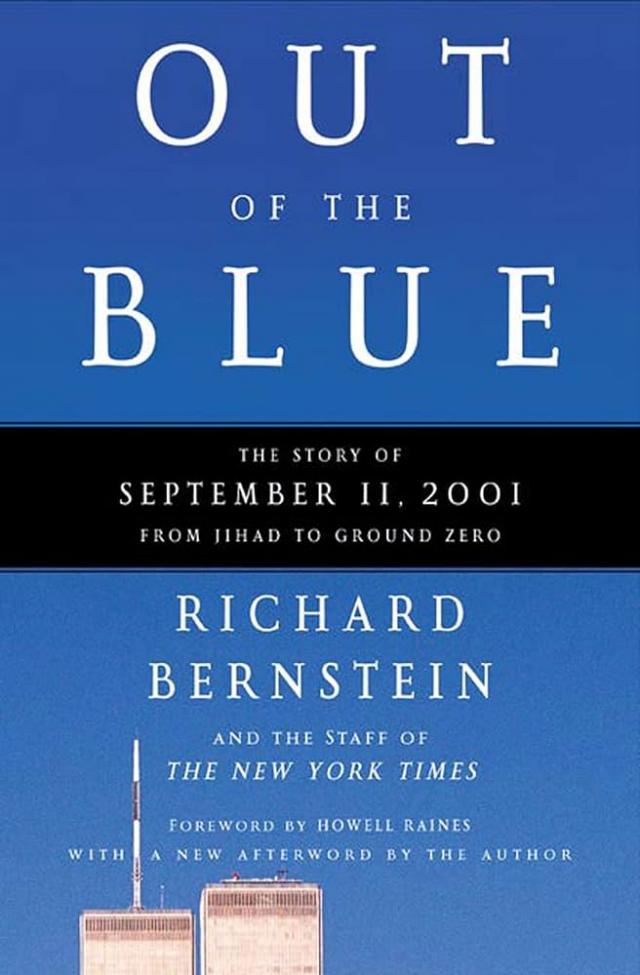
Out of the blue, p.1
Out of the Blue, page 1


The author and publisher have provided this e-book to you for your personal use only. You may not make this e-book publicly available in any way. Copyright infringement is against the law. If you believe the copy of this e-book you are reading infringes on the author’s copyright, please notify the publisher at: us.macmillanusa.com/piracy.
Contents
TITLE PAGE
COPYRIGHT NOTICE
FOREWORD by Howell Raines
AUTHOR’S NOTE
ONE “We Saw People Jumping”
TWO Peshawar: The Office of Services
THREE “We’re Due for Something”
FOUR The Young Man from Saudi Arabia
FIVE Glick and Jarrah: An Open Life and a Closed One
SIX Terrorism Arrives in America
SEVEN Harry Ramos and Victor Wald: The Courage of Strangers
EIGHT “In Time of War There Is No Death”
NINE Yeneneh Betru: Medicine for the Neediest
TEN The Cell in Hamburg
ELEVEN John Ogonowski: Salt of the Earth
TWELVE While America Slept
THIRTEEN Richard A. Penney: Project Renewal
FOURTEEN The Commandos in America
FIFTEEN Peter J. Ganci: Born to Fight Fires
SIXTEEN The Terrorists Stay One Step Ahead
SEVENTEEN Like a Knife into a Gift-Wrapped Box
EIGHTEEN “Protect the White House at All Cost”
NINETEEN “We Had a Lot of Dying and Fire Up There”
TWENTY The Towers Come Down
TWENTY-ONE A Nation Suspended
TWENTY-TWO Aftermath
AFTERWORD
NOTES
ACKNOWLEDGMENTS
INDEX
ALSO BY RICHARD BERNSTEIN
ABOUT THE AUTHOR
COPYRIGHT
FOREWORD
Howell Raines
The title of Out of the Blue captures exactly the stark, heartbreaking nature of what happened in the home city of the New York Times on the morning of September 11, 2001. “Out of the blue” also expresses the suddenness with which the American people were confronted with a new kind of war. Not since Pearl Harbor had United States territory and the American psyche been so abruptly assaulted. It seems to me that every New Yorker, every American, and people around the world will make some personal connections with these four words. I think, for example, of the photograph published on the front page of the Times on September 12 showing the second airplane approaching the south tower of the World Trade Center. The first time the editors saw that photograph, we knew that we were seeing a freeze-frame of a world-altering moment. Richard Bernstein, for his part, opens this book with a meditation upon another stark picture—that of a man, upside down, falling to his death from one of the towers on “a glorious fall day.” It is an image that sums up the transience of life, the finality of death, the timelessness of the universal sky, and perhaps most of all the fragility of peace.
Some journalism critics and a few readers complained about our decision to print that picture. It was a decision debated in an editors’ meeting on September 11, and we considered whether friends or loved ones might be able to recognize the falling man. Bernstein’s eloquent description of the picture convinces me that its use was the correct journalistic response. Sometimes tragedy must be confronted directly, for it is an indelible part of the human experience. How terrible, for instance, are the pictures of the emaciated survivors of the Nazi death camps, how heartrending Robert Capa’s photograph of an infantryman being shot in the Spanish Civil War. And how much less would we understand our world if we did not have those images to instruct us about the agony of war and the killing power of hatred in our world.
As daily journalists, of course, we do not set about our work with the idea of being teachers or moral historians. We are engaged in an intellectual enterprise built around bringing quality information to an engaged and demanding readership. Sometimes that means writing what some have called the first rough draft of history. Sometimes it also means constructing a memorial to those whose courage and sacrifice we have recorded or—to speak more precisely—erecting a foundation of information upon which our readers can construct their own historical overviews, their own memorials to those who are lost and to the struggle to preserve democratic values.
I offer these observations on journalistic process because as executive editor of the Times, I have a responsibility to the 1,100 men and women of our news department to recognize an extraordinary performance that produced six Pulitzer Prizes, two George Polk Awards, and honors from the Overseas Press Club and the American Society of Newspaper Editors. The work of this generation of Times journalists can stand alongside the best work of our 151 years of newsgathering—in the Civil War, at the dawn of the nuclear age, on the frontiers of space. But you will not find our journalists as actors in the pages that follow, for every writer, photographer, editor, graphic designer, researcher, and support staff member in our newsroom and our bureaus around the world understands that we are not the story. The story of how we got the story has its moments of drama and danger, but even that professional epic is not central to the pages that follow.
What Richard Bernstein, a gifted correspondent, author, and critic, has constructed from his original reporting and the work of his Times colleagues is a record of the things we observed in our roles as witnesses, recorders, and analysts. Bernstein has also drawn on the fine work of our colleagues at other news organizations, and we are proud to credit their contributions. The result is a masterly mosaic that when viewed in its totality gives us a comprehensive picture of the events of September 11, the forces and players that led to them, and the consequences that produced those events. We see the connections between an impressionable young Saudi millionaire and a radical Islamic preacher now serving a life sentence for the first attack on the World Trade Center back in 1993. We see links between a terrorist cell in Hamburg and a flight school in Florida. We glimpse as fully as we ever shall the heroism of passengers on United flight 93, which might have crashed into the White House rather than a field in Pennsylvania.
How fitting that this sweeping international narrative ends quietly with a chapter reminding us of the largest global constituency, those joined by the “democratic tombs” produced when thunderous events seem to roll out of the blue. In the final chapter, we meet Tsugio Ito, a man who lost a brother at Hiroshima and a son at Ground Zero. The first loss arose from dictatorial passions run amok in his own land, the second by a religious hatred that, one fears, has yet to run its course.
Here, then, is the story up to now, as produced by a news staff whose ability, endurance, and sacrifice awed all of us who were privileged to be part of their enterprise.
AUTHOR’S NOTE
There is no universally recognized method of transcribing Arabic into English, and that explains why this book, and other books on related topics, contain inconsistencies in their transcriptions of Arabic words and names. Family preferences and historical usages have meant that the same letters in Arabic can come out in two or even three different ways in English. In this book, I have followed the spellings most commonly used in the New York Times. Thus, for example, Marwan al-Shehhi, not Alshehhi, and Nawaf Alhamzi, not al-Hamzi.
ONE
“We Saw People Jumping”
The forms, sometimes not much more than specks against the gleam of the skyscraper, tumbled downward almost indistinguishable from the chunks of debris, the airplane parts, the vapors of flaming aviation fuel that filled the air like fireworks. They fell at the rate of all falling bodies, thirty-two feet per second squared, slowed a certain amount by the friction of the air, so they fell for eight or nine seconds and they were going at least 125 miles an hour when they hit the pavement or crashed into the roof of the Marriott Hotel at the bottom of the World Trade Center. It took a few instants for the witnesses to understand what they were seeing: that the forms silhouetted against the sky or against the flaming buildings themselves were bodies; they were men and women who had chosen to leap to their deaths from a 110-story building rather than endure the conflagration that had engulfed them inside.
Those eight or nine seconds made up the dreadful interval remaining to these victims, an interval spent hurtling past the vast geometrical precision of windows and pillars downward to death. And then everything, the towers themselves, all 110 ten stories of them, the entire 1,368 feet of the north tower, the 1,362 feet of the south tower with their 400,000 tons of steel and their 10 million square feet of offices, trading spaces, bathrooms, and conference rooms disintegrated in an avalanche of concrete, steel, glass, airplane parts, and thousands more bodies, all compressed into seven stories of rubble below.
The television stations and the newspapers delicately chose not to show too many images of the falling bodies. But there was one photograph published on September 12 in the New York Times that captured the horror. It was of a man in a white shirt and dark pants and what looked like large shoes or boots falling headfirst, upside down, frozen for all time against the background of one of the twin towers, which is a ghostly, silvery white in the morning sunlight. September 11, 2001, as many have ruefully noted, was a glorious fall day. It had to have been for the pilots of the hijacked airplanes to see clearly enough to carry out their missions. The autumnal glitter brought the event into sharp focus for those who witnessed it nearby and for the hundreds of millions around the world who watched it unfold, in real time, on television. And so, the camera was able to record the falling manâ €™s descent with icy clarity. It is an outlandish, incongruent image, surreal, absurd, a man suspended in a place where no human being should be. It is easy not to realize, stilled by the camera as he is, that his experience of falling and ours seeing the image of his fall are utterly different. Going headfirst like he was, the air resistance would have been minimal, and he would have reached a speed of close to 170 miles per hour before he hit … whatever it was that he hit below. It is a gruesome detail, but it is details like that that make up a tragedy; it is their accumulation in the experience of thousands of victims that adds up to the human cost of September 11.
It was a large event, three dimensional, and any one person seeing it on the ground saw only a narrow fragment of it, like George Shea, for example, a public relations executive who was in a car just emerging from the Brooklyn Battery Tunnel and heading north on the West Side Highway when American flight 11 hit the north tower. He saw an immense wheel materialize from above—he assumed it was the wheel of the airliner—strike a blue-gray SUV in front of him and then bounce away into a building. The director of graduate admissions at the Nyack College Alliance Seminary, Carol Webster, saw no airplane parts crashing to the ground; what she saw was people getting hit and burned by aviation fuel, people dropping purses so their money fell out, people dropping their children as they ran and other people behind them stopping to pick them up, and then running too.
But it was the falling bodies, the desperate suicidal leaps caused by the actions of suicide terrorists that made for the grimmest images, the images that would haunt forever those who were there to see them with their own eyes.
They were anonymous. Like the man pictured in the New York Times photograph, those who jumped remain unidentified and unenumerated. The tragedy of September 11 was televised; millions around the world saw it in their own homes as it happened in lower Manhattan. And yet these hundreds of millions of spectators watching simultaneously in France and Japan, Brazil and California, could not see the event’s human details, which were obscured inside a fog of dust and debris. And therefore, the jumpers died in a paradoxical sort of obscurity, their deaths witnessed but their identities unknown. And it’s not just that we don’t know who they were; we also don’t know how many of them there were among the 2,813 who died when the planes hit and the two towers disintegrated behind the billowing curtain of dust and debris visible to the world that watched. But videotapes scrutinized later show that there were at least sixty people who jumped or fell, almost all from the north tower, the first to be hit.
An emergency medical technician named John Henderson was on Fourteenth Street when he and his partner, Lou Parra, heard the sound of the plane hitting the north tower, and the two of them then raced toward the scene. They could see heavy pieces of debris falling from the gash that the plane, a guided missile with ten thousand gallons of aviation fuel on board and edges like knives, made as it tore into the tower, shattered the aluminum façade, sliced through eighteen-inch-thick exterior steel columns, and erupted in flames. They saw shards of the plane that left streaks of sparks against the tower’s vertical lines. Then they saw bodies begin tumbling down, one, two, three, men in business suits and white shirts, then another and another.
“We saw people jumping,” Leonore McKean, a paralegal at the brokerage firm Merrill Lynch, said. When the south tower was struck about twenty minutes after the north tower, Ms. McKean was evacuated along with the rest of her office. “We had to walk north. I saw what might have been a piece of the engine from the plane. You could hear people screaming as they saw people jumping.”
But nobody heard the jumpers. They fell in what seemed like silence, though very likely they were screaming too, as though echoing the screaming of the people below who saw them. And nobody knows what it felt like to be falling, what it felt like in their stomachs and bowels to leap from so terrifying a height and to drop like stones. Did the jumpers remain aware as they plummeted downward? Could they see the ground rushing up at them, the parked cars, the roofs of lower buildings, the pedestrians who had the luxury of running to safety? Did they see their lives pass before them, or think of their loved ones, whom they had kissed good-bye an hour or two before in what seemed like the start of just another day? Or did they black out as they accelerated, their guts churning, their lungs pressed flat against their diaphragms, their skin scorched from the burns they suffered before they jumped? What was it like to be sitting at a desk one minute, perhaps to be sending an e-mail or drinking a cup of coffee or checking the schedule of the day to come, and the next instant to be pressed so hard by the hot iron of burning aviation fuel against the exterior walls of the office that you tumbled out in your desperation to get away?
We know that at least a few survivors from the stricken towers, people who managed to climb down the stairs to safety, actually saw the planes banking in the morning air just instants before they struck. But what of the victims? Did any of them happen to be looking outside their windows, perhaps admiring the view of the Hudson River as it flows past Manhattan’s West Side, and actually see the airplane, its fuselage glinting in the sun, hurtling right at them? Did they dive for cover or did they stand there transfixed by the inconceivable, like a deer caught in headlights? Did they understand for a flickering instant that men from faraway countries whom they had never met and didn’t know were bent on the task of murdering them? And those who didn’t jump—those, for example, among the 160 or so people who were having breakfast in Windows on the World, the restaurant with the million-dollar view on the 107th floor of the north tower, or the 135 people attending the Risk Waters Financial Technology Congress one floor below? When the buildings collapsed, were they killed instantly, painlessly, or did some of them remain conscious for a few seconds as the once solid, carpeted floor dematerialized beneath them and they fell, at the same speed as their desks and water coolers and file cabinets and computer terminals and boxes of paper clips and framed photographs of their children?
On Park Place, the busy commercial thoroughfare near City Hall, pedestrians heard the whine of the jet and some who looked up saw the plane coming in extremely low. And then they saw people jumping out of the building. One person said he was even able to make out a lady in a green suit and a man in jeans, both jumping out and falling to their deaths. Another witness, a photography student named Jamie Wang who had been taking pictures of people doing tai chi exercises in a nearby park, described the jumpers as figurines. He remembers one woman in particular, the way her dress billowed out in the wind created by her fall. Firemen rushing to the scene reported that they had to dodge bodies being propelled from windows on the upper floors.
“I saw at least ten people jump,” one fireman said. “I heard even more than that land and crash through the glass ceiling in the atrium. We could hear them crash. We thought the roof was crashing down, but then we looked up and saw that people were falling through the glass. Some people fell right onto the pavement.”
People getting out of the towers, walking down the stairs and out onto the plaza level, saw them too, even though, once they had arrived on the scene and began organizing the evacuation, policemen told them not to look. “There was a head, a whole body, just mangled, two feet with shoes on them,” an evacuee from the 82nd floor said. “I saw heads. I saw feet.” People watching from their offices in buildings whose chief attribute was the view they offered of the trade center saw a ball of fire erupt from near the top of the north tower and then some of them said they saw as many as twenty people jump, some of them blown by the wind around the corner from where they had started.
A veteran lieutenant in the Fire Department, a member of the elite Rescue I squad in midtown Manhattan named Steve Turilli, was searching for a command post near the Customs Building on West Street, which runs between the Trade Center itself and the World Financial Center closer to the Hudson River.
“That’s when we started to get hit by all the bodies, or people, jumping out of the towers,” he said. “You would get hit by an arm or a leg and it felt like a metal pole was hitting you. It was like a war zone, seeing body parts everywhere. Then we’d be hit by the bodies.”