

The book of sand, p.1
The Book of Sand, page 1
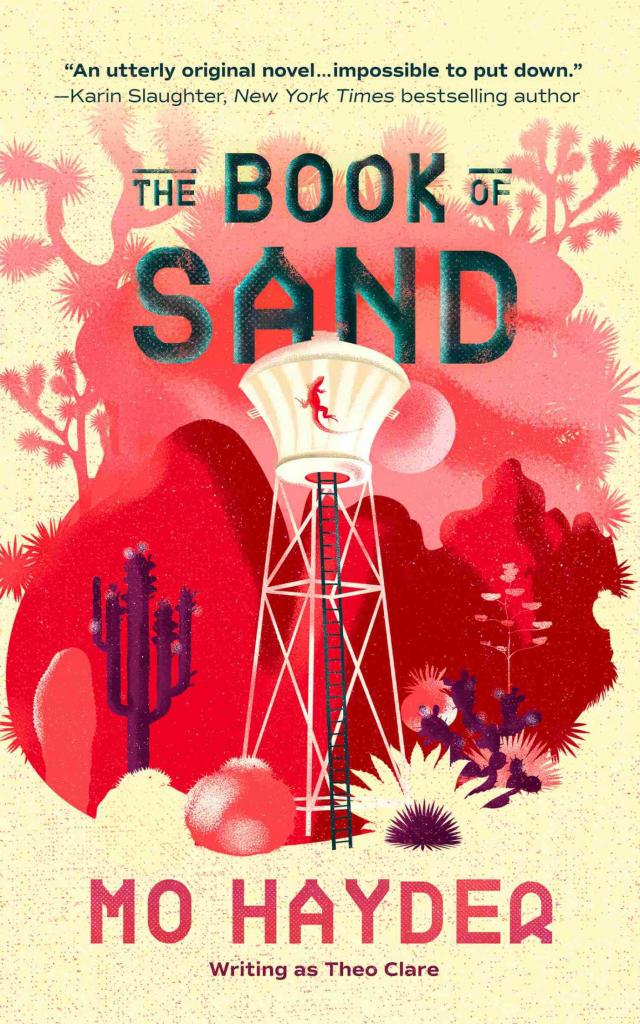


praise for
The Book of Sand
“Unique and fearless.”
—Mark Billingham, bestselling author of the Tom Thorne series
“I inhaled it! It’s beautifully written and utterly compelling.”
—Harriet Tyce, author of Blood Orange and The Lies You Told
“Audacious, extraordinary, and absolutely awesome.”
—Alex North, New York Times bestselling author of The Whisper Man
“An utterly original novel from an extraordinary creative mind, The Book of Sand is an absolute standout that’s impossible to put down.”
—Karin Slaughter, New York Times bestselling author
“Fearless and compelling, lyrical and devastating by turns, the story never slackens pace. A stunning introduction to a wholly original world.”
—Jane Corry, bestselling author of My Husband’s Wife
“A future classic that exists between darkness light. I was completely entranced by it.”
—Christopher Fowler, award-winning author of the Bryant & May mysteries
“A huge and brilliant and engaging read. It feels like a place I have been to rather than words on a page.”
—Alice Jolly, award-winning author of Mary Ann Sate, Imbecile
Copyright © 2022 by the Literary Estate of Theo Clare
E-book published in 2022 by Blackstone Publishing
Cover design by Sarah Riedlinger
Map © 2021 by Darren Bennett
All rights reserved. This book or any portion thereof may not be reproduced
or used in any manner whatsoever without the express written permission of the
publisher except for the use of brief quotations in a book review.
The characters and events in this book are fictitious.
Any similarity to real persons, living or dead, is coincidental
and not intended by the author.
Trade e-book ISBN 979-8-200-92041-9
Library e-book ISBN 979-8-200-92040-2
Fiction / Fantasy / General
CIP data for this book is available from the Library of Congress
Blackstone Publishing
31 Mistletoe Rd.
Ashland, OR 97520
www.BlackstonePublishing.com
This book, and the series, is dedicated to all those who have been affected by Motor Neurone Disease.
I know I am deathless . . .
Walt Whitman, “Song of Myself,” 20
Part One
The Family
1
Here he is in the farthest corner of an antique desert, just one of a string of people who move silently across the sand. The ferocious heat shimmers, although the day is on the wane and sunset isn’t. Some days this place is all Spider can remember. His skin is crusted with sweat, his tongue swollen, his feet sore, but he’ll keep going, he has no choice with the sun sinking so fast.
The family are eleven in total, a raggle-taggle assortment, ranging from a child of five to a huge gray man in his sixties, and though some are able-bodied, others are less so. Spider knows that of all the family he’s the strangest sight—though he stands almost two meters tall, is whiplike, and healthy as a young tree, it’s his clothes that set him apart: he wears desert boots, aviator goggles, and a tattered woman’s dress, which the slight breeze causes to flap lazily against his tanned legs. He leads the family’s single camel, laden with equipment; the camel is as downcast as the family, forlorn and battered, and she drags her feet, and her humps are pitifully slumped.
Next to Spider walks Amasha: squat and round-figured, moving like a regal ocean-going ship, her veils fluttering around her face. In her expression there is no urgency, no betrayal that she feels the same fear as the rest of the family.
Spider glances over his shoulder to check the family are keeping up. The little blond-haired girl, who has been trotting bravely next to the camel for the last two hours, is crying with fear.
“Hey,” he mutters, leaning his head sideways to Amasha. “Have you seen?”
Amasha doesn’t turn back to look—she keeps her eyes fixed on the horizon. “Of course. She’s scared. But we can’t stop.”
“She’s crying.”
“I know, I know. But for the sake of the family, we can’t stop. She has to keep up. She knows we have to get home. Don’t pay attention, she will soothe herself.”
Spider wraps the camel’s rope tighter around his fists and leans into the walk, putting everything he has into it. His eyes are itchy with tiredness, but he keeps going, placing one foot after the other, registering the places on his neck where his skin has burned in the last two days, the point in his boots where the leather is thin and rubbing his sole. He doesn’t look up at his surroundings, the long featureless tracts of sand, up to forty clicks in every direction, the distant cities and structures of iron. Vast funnel-shaped towers, some as much as a hundred meters tall and a hundred wide. Now that the sun is setting, the structures cast shadows immense as mountains collapsed across the sand.
The little girl cries louder now. Spider stops, and the camel stops obediently next to him. He ducks under the camel’s neck and bends to take the little girl in his arms, but before he can hoist her up onto his shoulders, Noor, the tall man at the head of the train, turns.
In his late twenties, he is dressed in traditional kurta pajamas of pale gold, his hair is straight and groomed, his nose high, shoulders square, and he has the natural authority of a pope. He narrows his eyes at Spider, gives his head a faint but unequivocal shake—reminding him not to disobey Amasha.
Spider lowers his arms, crouches to the little girl, who is crying hard.
“Now listen, you’ve got to keep walking—it’s almost night. You can rest soon, but for now you’ve got to keep going. You hear me?”
“I don’t wanna walk. I’m scared.”
“I know that. I know you don’t want to, and I know you’ve tried your best all day long and you’re totally flaxed, tired as a frickin’ dog, but you got to keep going. Think of it like a competition. You and Cairo or Mahmoud—who’s gonna be home first?”
The girl rubs her eyes, and her bottom lip sticks out as she swings her sullen gaze toward Cairo and Mahmoud, the little boys at the back of the line. “Extra pancakes if me first?”
“That could be arranged.”
She lets out a long sigh. Kicks the sand with her open-toed sandals. “OK. Maybe.”
And so they walk on, Spider lowering his eyes against the late sun, dragging at the camel’s halter.
It starts again when McKenzie hits junior year at high school.
She wakes one morning at three. She doesn’t need to look at her clock, she can tell the time from the position of the constellations above her skylight, so she lies on her back, blinking at them, trying to decide what woke her. There are goose bumps on her arms as if she’s midnightmare.
She takes a deep breath, from the lower ribs, because Mom says that yoga breathing is the most calming thing you can do. The room is normal, nothing out of place, the posters of the desert on the wall, the roof windows wide open, although it’s freezing. She squirms her hand down into her bed, searching for Cuddle Bunny.
She’s had Bunny since she was a kid—maybe he’s her best friend after India, the one she tells all her secrets to. She feels him warm against her belly, touches him, but there’s no fuzzy velour. No floppy stitched-up ears. Instead, a warm and scaly skin.
She gasps, and Cuddle Bunny moves, squirming hard and muscular, something scratching her belly. She pushes herself off the bed and lands in a crouch, her heart racing—hands out in front of her. The quilt is moving, undulating. She backs away from the bed, half on her hands and knees, gets to the wall, trembling, and throws the light switch.
The bedspread moves, and a head appears from under it. A lizard of some sort, but like nothing McKenzie has ever seen in her life; buff in color, it has a dinosaur-like ruff of horns around its neck.
It blinks, then ducks back under the covers, fighting with them until it reaches the end of the bed. It drops off the bed with a thud and disappears beneath it.
She throws the door open, steps through, and slams it behind her. She stands for a moment, her heart pounding, then, taking the steps two at a time, canters down the staircase to the second floor. “Mom?” Her throat is so tight with terror the word hardly comes out. “Mom?”
She gets to the next story down, the long passage where, dotted along the wall, at foot height, are little flower-shaped night-lights. Her brothers occupy the two bedrooms on the left—their doors are closed—and, at what seems an impossible distance, Mom and Dad’s bedroom door. Closed. She’s never seen Mom and Dad’s door closed at night; they always leave it open.
Very, very carefully, she tiptoes into the passageway, past her brothers’ doors. The bathroom on the right, the door is open, a gaping hole—a triangle of mirror just visible, cut in half by a robe hanging on the towel rack.
She stands next to Mom and Dad’s door, her forehead almost touching it. She raises her hand to knock—it’s the polite thing to do—but changes her mind.
“Mom?” she whispers into the door crack. “Mom? Dad? Are you awake? Mommy? Please?”
She shivers. Her feet are bare, her vest and pajamas are thin.
Can she hear scratching on the stairs above? “Mom? Please?”
On the other side of the d
All so safe. She pushes the door a little wider, cringing at the squeak. The room is so familiar—blue moonlight from the squares of the windows. The gentle in-and-out sounds of Mom and Dad sleeping.
“Dad?”
A sharp voice from the other side of the room. Dad’s voice. “Kenz? What’s happening?”
On the king-size bed, Mom is sitting up, rubbing her eyes sleepily. “Kenz? Honey?”
“Mom?”
“What’s up, honey?”
“I . . . I don’t know. I . . .”
“Sweetie?” Dad says sleepily. “What’s happening?”
“Mom, Dad, there’s . . . I think there’s something in my room. You’ve got to come and see.”
Sunset. Spider hates sunset. He hates the way the day seems to sag, like rotting fruit, and the familiar smell that arises, as if the ground has opened its maw. Mostly, he dislikes the fact that no one in the family will remark on it, as if talking about it or naming it could give it more power than it already has.
Noor waves his arm to muster the dawdling family. “Let’s do it,” he shouts. “We’re running out of time.”
Spider leans forward, putting extra muscle into it, dragging the exhausted camel across the sand, through the cacti that surround this area, while behind him the family ramp up their efforts. The pattering and hard breathing, the subtle spatter of sand underfoot. No one wants to be out here after dark.
Half a kilometer ahead of them, the family’s home tower rises up against the hazy desert floor. It is enormous; with a footprint bigger than that of the Eiffel Tower, it blocks out a huge quadrant of the darkening eastern sky. Its walls are riddled with rust—the sands and the salty desert winds have driven huge holes into it. An attempt has been made to paint it, to smarten it up in desert-bloom shades of violet and pale pink, but the air has flaked and cracked the paint, so now it hangs in strips as if scabs are dropping from it.
Spider’s skin is olive, though he can still burn in the relentless heat. His hair is corn blond, and his eyes are the blue of his father’s, and he struggles in this desert, always squinting, the sunlight seeming to find this special weakness in him and push its advantage. People tell him he has a fighter’s face, they say he always seems to be expecting a punch from nowhere.
Nobody speaks. At the tower Spider hitches Camel to a spike on the outer wall while he helps Noor unshackle the gate. The noise of rusting metal on metal booms around the tower, causing the family to glance anxiously over their shoulders at the empty expanses of sand around them.
Spider holds the door open and waits for every member to hurry inside. Exhausted, they nod but barely glance at him. Just as most of them are inside, the two boys at the back, Mahmoud and Cairo—always competitive, always causing trouble—dodge to the front of the line.
Tita Lily keeps her eyes on them—she half cries when she sees them moving forward. She ticks them off about their clothing and their lack of sunscreen. She worries about them not taking their hats, she worries about them showing too much skin. She is a proper worrier, Tita Lily, and cannot keep her eyes off the boys.
Cairo is trying to prove he is faster than Mahmoud—an impossibility, because the little boy, Mahmoud, is taller and stronger—but as he does so, he runs past Tita Lily. She is walking as she usually does, with her head held high, trailing her way between the cacti. She doesn’t see them until it’s too late. She trips over Cairo and is dragged by his momentum about a meter, against a cactus, before he stops, his hands out to her, a look of terror and guilt on his face.
“Tangina!” she yells into the sand. “You crazy son of bitches . . .”
Amasha comes back out of the tower, and then, when Tita Lily doesn’t jump up, the others stop and return. She is lying facedown, holding down the white Grace Kelly hat over her dark hair. Her sunglasses have come off, and there is a small stain of blood drifting up her white dress.
“A cactus,” Forlani says. He goes to her on his crutches, crouches as best he can, and tells her not to move. “Did you get dragged across a cactus?”
“Yes. Get me upstairs,” she whispers.
Elk and Hugo come back and lift Tita Lily effortlessly—she is tiny and wiry—and carry her into the tower, Forlani hobbling along next to her. There is a trail of blood, Spider sees, dark-red blood, and he doesn’t want to think of the scent it might leave.
He unhooks Camel and leads her into the tower, then turns and sets about slamming down the giant bars on the back of the gate. He is one of the strongest of the family, so this task comes to him—the other family members each have an allotted chore, and now they scatter in the dimly lit tower to perform them.
The older family members check all entrances to the tower are still secure, while the little girl, Splendour, joins the two boys, both shamefaced now, and they work as a gang, checking water supplies and turning on the power supply from the solar panels. Madeira, the farmer’s daughter, a cigar tucked behind her ear, goes to her crops, lifting the plastic coating to confirm the irrigation system hasn’t been tampered with, and reads the little thermometers. There are the animals to check on too. She dips her fingers into the water troughs and scatters grain for the chickens, four buckets of swill for the pigs.
In the middle of the disorder stands the moth-eaten camel, patient while Spider unloads their camping equipment. He hauls the bags across the sand to the lockers that are dotted around the base of the tower and throws them inside, securing each locker with a strap. He is drenched in sweat, and his mouth is sour and dry from the cured rabbit meat the family have lived on for two days.
The family’s home—the Shuck, they call it—hangs like a vast seedpod sixty meters above them, something that seems to have grown naturally like a gourd or a tumor up in the air. The access is a spindly iron ladder to its underside, where, hazy in the dwindling light, is the giant iron lock that permits entry and exit. The two carrying Tita Lily have made it to the top of the ladder and are braced there, Hugo holding her and Elk unlocking the door. Forlani is a few rungs beneath them, holding his hands across her side. His face is covered in the dark blood that weeps from her.
As Spider gets the last of the equipment stowed, he sees a slash of red high on the wall. It is the low sun throwing a single blade of light into the tower—a sign that night is upon them.
“Keep up the pace,” he yells. His voice echoes round the tower. “Eight more minutes.”
The family’s sense of urgency increases, the tasks are finished hurriedly. Splendour is crying again from fear and exhaustion, but Spider can’t go to her. He lets Amasha herd her and the remaining family members toward the center of the tower. There are thirty meters of ladder to climb, and the children are pushed to the front to get started. Spider leads Camel to her cage as, out of the corner of his eye, he sees the children make their way up, strung like vivid beads on a necklace in the late sun. Noor and Amasha bring up the rear: Noor’s long, muscular shins are revealed under the gold pajamas, while Amasha’s jeweled hands and forehead glint. She hauls her bright pink sari up above her thighs so that it rucks around her hips. There’s no vanity here; she has to climb. Her arm muscles bulge fat and square with the effort, and sweat stains the silk.
Camel’s cloven lip is trembling and crusted black. Smears run from her eyes. She is exhausted. Spider whips up the rope and tugs at her halter. “Come on, girl.” He makes a soft click in his throat. “Come on.”
She’s a curmudgeonly character and needs to be coaxed, so he doesn’t drag at the halter but eases her along. She needs to be in the protective cage before he can trust himself to leave her. He’s made the cage with a cobbled-together arc welder; it is thirty centimeters off the floor because somehow he thinks that will protect her. He has to ease her up the ramp.






