Elliot jelly legs and th.., p.1
Elliot Jelly-Legs and the Bobblehead Miracle, page 1


Orca Book Publishers is proud of the hard work our authors do and of the important stories they create. If you are reading this book and did not purchase it or did not check it out from a library provider, then the author has not received royalties for this book. The ebook you are reading is licensed for single use only and may not be copied, printed, resold or given away. If you are interested in using this book in a classroom setting, we have digital subscriptions with multi user, simultaneous access to our books, or classroom licenses available for purchase. For more information, please contact digital@orcabook.com.
ivaluecanadianstories.ca
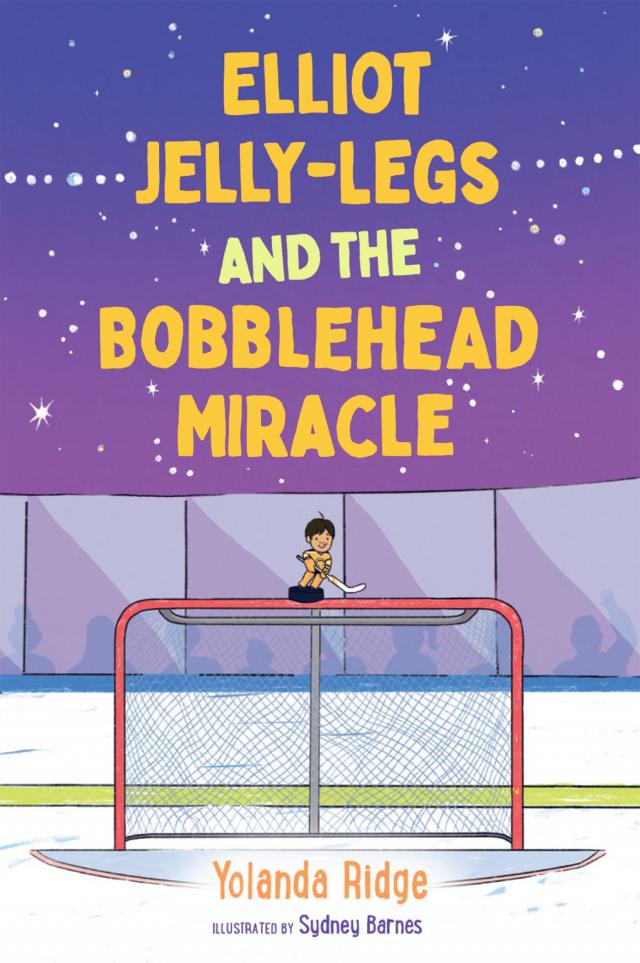
Elliot Jelly-Legs and the Bobblehead Miracle
A novel
Yolanda Ridge
Illustrated by Sydney Barnes
Text copyright © Yolanda Ridge 2023
Illustrations copyright © Sydney Barnes 2023
Published in Canada and the United States in 2023 by Orca Book Publishers.
orcabook.com
All rights reserved. No part of this publication may be reproduced or transmitted in any form or by any means, electronic or mechanical, including photocopying, recording or by any information storage and retrieval system now known or to be invented, without permission in writing from the publisher.
Library and Archives Canada Cataloguing in Publication
Title: Elliot Jelly-Legs and the bobblehead miracle : a novel / Yolanda Ridge ; illustrations by Sydney Barnes.
Names: Ridge, Yolanda, 1973- author. | Barnes, Sydney, illustrator.
Identifiers: Canadiana (print) 20220185468 | Canadiana (ebook) 20220185492 | ISBN 9781459833791 (softcover) | ISBN 9781459833807 (PDF) | ISBN 9781459833814 (EPUB)
Classification: LCC PS8635.I374 E45 2023 | DDC jC813/.6—dc23
Library of Congress Control Number: 2022934492
Summary: In this illustrated middle-grade novel, eleven-year-old Elliot relies on his Carey Price bobblehead doll to help him excel on his hockey team.
Orca Book Publishers is committed to reducing the consumption of nonrenewable resources in the production of our books. We make every effort to use materials that support a sustainable future.
Orca Book Publishers gratefully acknowledges the support for its publishing programs provided by the following agencies: the Government of Canada, the Canada Council for the Arts and the Province of British Columbia through the BC Arts Council and the Book Publishing Tax Credit.
Cover and interior design by Sydney Barnes
Edited by Tanya Trafford
For Spencer. Thank you for turning me into a hockey mom and showing me what determination can accomplish.
Don’t be discouraged from the improbable.
—Carey Price
Chapter 1
“It’s the most important penalty shot of the season.”
Duncan points his plastic mini stick at me before continuing in a deep sportscaster voice.
“Star goalie for the red team, Elliot Feldner-Martel, crouches into position. The outcome of the game rests entirely on his shoulders.”
Feet planted, I sink lower and narrow my eyes at my best friend. He keeps talking as he rushes toward me. “Duncan Bilenki, lead scorer for the blue team, stickhandles into the zone. He dekes to the right, waits for the goalie to commit, then snaps a laser toward the open side—”
My legs feel like they’re being ripped in half as one socked foot slides away from the other. I’m a millisecond too late. The ball curves past my outstretched pad into the small net behind me.
“—and scores!” Duncan pumps his fist.
“I wasn’t ready!” I shout, even though I was totally ready. The angle of Duncan’s shot was as obvious as an illegal crosscheck. I should’ve blocked it. He had even told me what he was going to do. Not that he needed to—I know all his moves.
We play hockey pretty much every day. When it’s too cold to play in the street, like today, we play mini sticks in Duncan’s basement.
It’s only September, but the rain outside is thick enough to resurface an ice sheet. We’ve been shooting a tennis ball at each other with our mini sticks for so long that the high windows of the basement are covered in steam.
“Reset!” I scramble to my feet and pull the ball out of the netting, tugging harder than I need to.
Duncan taps his stick against his palm. “Attention, sports fans,” he announces to our imaginary audience, “there will now be a short delay while Feldner-Martel does his famous Patrick Roy routine.”
This is Duncan’s way of complaining about how long it takes me to get set. It might bug me if someone else said it, but with Duncan I don’t mind. Duncan gets away with a lot of things I wouldn’t put up with from others. There’s something about him—he wins over everyone he meets, and he’s good at everything he does. A couple years ago some of the hockey kids started calling him Can Can after someone said, “If anyone can do it Dun-can can.” It’s true.
“Patrick Roy’s not the only NHL superstar who’s superstitious,” I say as I line the net up with the floor tiles. “Sid the Kid wouldn’t call his mom on game days. The Great One refused to get his hair cut on the road. And Glenn ‘Mr. Goalie’ Hall used to throw up before every game—”
“On purpose!” Duncan finishes with a grin.
I hit my blocker three times before tapping each goalpost in the exact same spot I tapped last time. I don’t talk to my goalposts like Patrick Roy did, but I feel less alone in net when I remind myself the goalposts are there. Leaning back until I can feel the crossbar behind me, I take a deep breath, shake my head and narrow my eyes at Duncan to get focused. “I’m ready. Bring it on.”
“Want to switch?” he asks.
Both of us like playing goal, so we always split our time in net. I’ve already gone through my whole goalie routine, though. “One more. Then we’ll switch.”
Duncan nods to make sure I’m ready before pushing the tennis ball forward with his stick. I come out to challenge. He unleashes a slap shot. From my knees, I throw up a blocker. It looks like the ball’s going to beat me top shelf, but at the last second I snag it with my glove.
“Great save, Elliot!” Duncan’s dad stands at the bottom step, clapping. He’s still dressed in his Canada Post uniform. “You’ve got good hands.”
“Thanks, Coach Matt.” My tongue trips a little on the word Coach. I’ve known Duncan’s dad almost as long as I’ve known Duncan—since kindergarten, when he let me borrow a stick so I could play street hockey with him and his cousins instead of just watching—yet I still don’t know what to call him. He doesn’t want me to call him Mr. Bilenki. But it feels weird to call him Matt. Besides, my dad would kill me if he heard me refer to any adult by their first name.
When Duncan’s dad coached our hockey team last year, everyone called him Coach Matt. That felt right. Except now we’re in his basement, not at the rink.
“Sorry to interrupt you, boys,” he says, picking up the remote, “but the game’s on.”
The big screen flickers to life, and Coach Matt’s glasses explode with color. He rubs his hands together like he’s about to dive into a bowl full of candy. “Everyone at work was talking about this preseason matchup between Vancouver and Calgary. I bet the whole town will be tuning in.”
He’s probably right. Since Trail is halfway between Vancouver and Calgary, people who live here either cheer for the Canucks or the Flames. There’s the odd Oilers fan too, which keeps things interesting.
As the pre-game analysis cuts to commercial, Duncan’s dad mutes the TV and flops down on the couch. “So are you excited about hockey season starting, Elliot?”
“Course.” I try to sound casual as a bead of sweat trickles down the back of my neck. I’m actually a bit nervous about moving up to U13—where everyone will be even bigger and faster than they were in U11—but mostly I’m pumped about getting a second chance to prove myself.
My mom and dad didn’t sign me up for hockey when I was younger. Mom was worried about concussions. Dad said it was too expensive. I think the real reason was that we were all too busy with other stuff. They were probably hoping I’d lose interest too. I never did. Last year—when things opened up after a year of no extracurricular activities at all—they finally caved and let me play.
I felt like I’d won the lottery.
But then I got on the ice.
Even though I was a pro at mini sticks and street hockey, there was a problem. Just a small one.
I couldn’t skate.
I worked to catch up, desperately trying to close the gap between me and my teammates (who could skate before they could walk). I went to every public skate I could. Most of the time the ice was too crowded for me to work on my edges and practice hockey stops. So I watched how-to videos on YouTube and practiced by sliding across my bedroom carpet in my socks. But no matter how hard I tried, I was always at the end of the line in every drill. And when it came to games, I was always in the wrong zone because I couldn’t keep up with the play.
This season things will be different. I’m sure of it.
An aerial shot of Rogers Arena appears on the screen, and Coach Matt unmutes the TV. “Come to think of it, I’m not sure I saw your name on the registration list, Elliot.”
“Huh.” My heart thumps so loudly I’m sure Duncan and his dad can hear it over the TV. My parents promised to sign me up! And I wrote the early-bird registration deadline on the calendar in permanent red marker so they
Duncan pulls on his Vancouver Canucks jersey over his damp T-shirt and plunks down next to his dad. “Hey, Dad, did you order pizza?”
He nods. “Mediterranean and Pepperoni Classic. Enough for Elliot too.”
My mouth waters as the opening notes of the national anthem flood the basement. “Thanks, but I told Mom I’d be home for dinner.”
As much as I want pizza, there’s no time to waste. I have to get home and convince Mom and Dad to sign me up for hockey before it’s too late. Otherwise I’ll be left behind. Again.
Chapter 2
When I get home, Mom’s in the kitchen. She’s talking into her headset as she makes dinner.
My sister’s sitting at the counter reading a book—How to Teach Your Dog Quantum Mechanics. This makes no sense, especially since we don’t have a dog. And even if we did, why would a dog need to know physics?
“Aislyn, where’s Dad?” I ask. He’s usually in his studio, but I don’t hear any noise coming from downstairs.
She answers without looking up. “Meeting with some people who want him to do a special carving for their yard.”
Perfect. This is my chance to ask Mom about hockey. But she’s so deep in conversation, she barely notices me as I motion for her to hang up. The pot on the stove looks dangerously close to boiling over. I give the water a stir.
Waiting would be easier if I could watch the game. But my parents refuse to pay for the sports channel. Or any channel. The only screen time they allow is for video games, because Mom read somewhere that it helps kids with hand-eye coordination and problem-solving.
“Want to play NHL All-Stars?” I ask Aislyn.
“I’m reading,” she replies. “Duh.”
“That’s a book? I thought it was your face.”
We both laugh. Jokes about how much my sister reads are pretty common in our house. Before we adopted her, she had bounced from place to place in foster care with a suitcase crammed full of books instead of clothes.
Mom finally ends her call, takes out her earbuds and pinches the bridge of her nose. I know she only does this when she’s really stressed.
“Need some help, Mom?”
Not that I would be much help. When it comes to cooking, none of us know what we’re doing. The kitchen is Dad’s domain. But I shred some cheese as Aislyn watches over the noodles, and after twenty minutes of total chaos, we sit down at the table with bowls full of something that resembles macaroni and cheese.
Now I can finally ask Mom about hockey. Just as I’m about to bring it up, she turns to my sister and asks her about school. Aislyn starts filling us in on every detail of her totally boring day.
I want to scream. Instead I start balancing my chair on two legs—practically daring Mom to interrupt my sister and tell me to stop. But Aislyn’s bragging about acing the math test we had today, so Mom doesn’t even notice.
“How did you do on the test, honey?” Mom asks, finally turning her attention to me.
Great.
My sister and I are the same age. And even though we’re in the same grade, we’re not in the same class. Aislyn gets really good marks. Me, not so much. So Mom asked them to separate us after she and Dad had a big fight about whether being together was bad for my self-esteem (Mom’s opinion) or a good way to motivate me to do better (Dad’s opinion). But this year both sixth-grade classes are doing math together, so separating us wasn’t an option, except when they divide us into groups of needs more practice and ready to move on.
I blow the air out of my cheeks. “Okay. I got 75.”
“Aislyn got 100 percent and you only got 75?” Dad asks as he walks into the kitchen. “Did you study at all?”
My chair hits the floor with a thud.
“Let’s not get into this now,” Mom says as Dad lifts the lid to see what’s left in the pot on the stove. “I was waiting for you to get home before telling them—”
Aislyn sets down her fork. “Telling us what?”
“Mom has good news.” Dad puts the lid back on and grabs one of his premade smoothies from the fridge. “Go on, then.”
Mom sits up a little straighter and grins at us. “I’ve decided to run for mayor.”
“What? Why?” When Dad said “good news,” I was hoping for something like a teachers’ strike or an extra month of summer holidays.
“Perhaps you should start with congratulations, E?” I can tell by Dad’s tone that he’s disappointed.
Before I can react the way he wants me to, Aislyn jumps in. “Congratulations, Mom!” She waves pretend pom-poms in the air, acting like Mom’s been nominated for president of the world. “Is this so you can fight the urban-farming bylaw?”
“Of course.” I hit my forehead with the palm of my hand. “The chickens.” Mom’s store sells all kinds of local stuff, including honey and eggs. For years she’s been fighting a bylaw that forbids beekeeping and backyard chickens.
“Yes, it’s partly about the chickens. But there are other issues I want to address as well.”
“This is a great opportunity for your mother. It’s going to take support from the whole family.” Dad takes a big gulp of his smoothie. As his words sink in, what’s left of my appetite vanishes.
“Which means there are going to be some changes around here,” says Mom. “To start with, you two can only sign up for one extracurricular activity each.”
Aislyn and I both speak at the same time.
“The Change Climate Change contest,” Aislyn says.
“Hockey,” I say.
Dad’s response is immediate. “Not hockey.”
The cheese in my stomach curdles. “Why not?”
“Too much time. Too much money—” By the way he’s using his fingers to list off the reasons, I can tell Dad’s just getting started. But I’m not going to give up just yet.
“Duncan’s dad will drive me,” I say. “And I’ll help pay. I can work at the store. Or apply for one of those grants Coach mentioned.”
Dad shoots me a look. “I’m surprised you want to play that badly, E. By the end of last year you had as good as given up.”
Heat pricks my ears. “I had not!”
Mom touches my arm. The weight of her hand calms me down. Sometimes I need to work on controlling what Mom used to call my Big Bad Wolf emotions. Huffing and puffing never gets me what I want, especially since we adopted Aislyn, who’s always so calm and reasonable. So I try counting to ten in my head and taking deep breaths like Mom taught me.
She turns to Dad. “We said one activity each, Jack. If this is what Elliot wants to do, we’ll make it work.”
“It’s too expensive.” Dad folds his hands on the table like a judge. “He will probably need new equipment. And we’ve already missed the early-bird deadline.”
I can see the big red circle I drew on the calendar from where I’m sitting. I blink and it multiplies, rushing at me like a mob of angry emojis. They didn’t miss the deadline. They ignored it.
My fists tighten into balls. Containing all the emotion bubbling inside me is like holding in a fart—I’m about to burst from the pressure.
“Besides, it’s not just the registration fees,” Dad continues. “It’s the jersey deposit and the tournament costs and the team fees…remember how it all added up last year?”
Aislyn and I exchange glances. Things always get tense when Mom and Dad talk about money, especially since they lost their accountant. That’s when Mom took over bookkeeping for both the store and Dad’s wood-carving business and put Dad in charge of household expenses.
“I’m sure I can convince the league to honor the early-bird price,” Mom says to Dad. “Is there enough money in the account to cover that for now?”
Silence settles over the kitchen. I cross and uncross my fingers behind my back like I always do when Mom and Dad argue about me. I have to do it three times, starting with my right hand, or things won’t go my way.
The clock above the sink ticks like a bomb. It feels like my life is on the line as I cross and uncross my fingers three more times.
Finally Dad clears his throat. “I’ll crunch the numbers and let you know.”