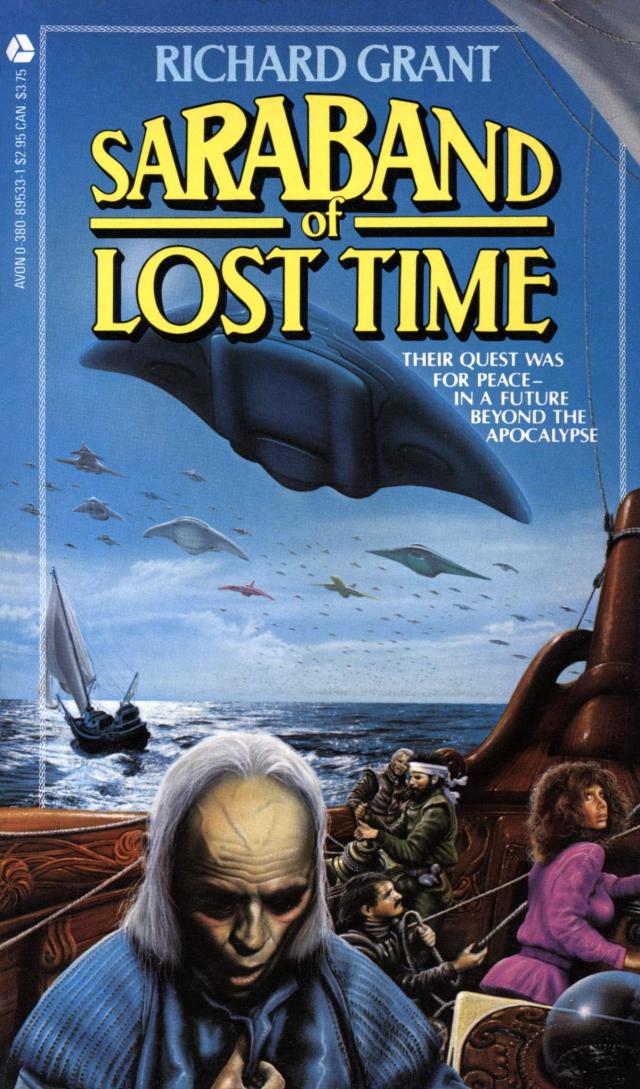
Saraband of lost time, p.35
Saraband of Lost Time, page 35


The Warmaster stood to welcome us. He said, “Hello, old friend,” or words like that, and Lord Inbote said hello and sat down on the sofa. The Warmaster was sitting in Lord Inbote’s chair.
As soon as we were really in the room I felt like there had been a flash of light but it was already over—as if a mirror had caught the sun for just a second. The room was the same. But the music-box had stopped and none of the machines in the kitchen were humming anymore, and the Warmaster said, “You have turned it on, haven’t you?”
“It was never off,” said Lord Inbote, “but yes. Isn’t that what you wanted?”
The Warmaster just smiled. He said, “Show me, old friend. Show me what it can do.”
Lord Inbote said, “You have gone to a great deal of trouble to arrange this. Are you quite certain you are ready?”
And the Warmaster said, “Are you?”
Then the room changed. We didn’t move, but all of a sudden we were in a different place, except that it felt like we had been there all along and only now understood. It was very bright, much brighter than before, and instead of furniture and walls there were panels of light under our feet and all around us. Also in this place there was a little man—a short man with glasses and a bald head. He was friendly but seemed surprised to see me and the Warmaster.
Lord Inbote said, “Hello again,” and the little man said, “Welcome back.” Then he said something odd which I remember very clearly.
It was, “You know, I gave some thought to passing it on this way. It’s quite a temptation, isn’t it, not to let go? Yes— but in the end I decided there was no one I was close enough to…to, you know, be in.” Then the little man glanced at me and the Warmaster and said, “Which of them have you chosen?”
Lord Inbote shrugged. He seemed very tired. He said, “This one says he loves me. The other hates me. Which should I reward with such a fate?”
Each time the little man frowned, his glasses slipped down his nose and he had to push them up again. He thought for a minute and then he said, “What do you want? How do you feel? If I may ask.”
Lord Inbote told him, “I love the truth. And I love beautiful things. Things that make the world seem young again. I hate time, because it eats away at them both—eats away at the guts of reality, as you so brilliantly described. I suppose what I want is to live forever in a way that time cannot destroy.”
“Perhaps you will. Perhaps your soul…”
“No. I do not believe that. I want to do it this way.”
“But you can’t. This isn’t life. This is only a machine, a matrix. A memory.”
Lord Inbote said he knew that. You could tell he was getting impatient.
Now the Warmaster stood up. He walked over and put his hand on Lord Inbote’s shoulder—there was nothing I could do to stop him, really—and he said, “You are going to give it up, then, aren’t you?”
Lord Inbote only stared, and the Warmaster said, “Why don’t you stay a while longer? I would love to talk to you. About all this. Listen to me, old friend.”
But Lord Inbote wouldn’t answer him. He only looked at the Warmaster and then at me and finally turned away.
I saw something then that 1 hadn’t seen before. Along one wall of the room or whatever it was, were these two gigantic black doors. They were perfectly black but they were also clear, like the sky at night, and they stretched up higher than I could see. Lord Inbote began walking toward them right away. He lifted his hands to push them open, and the little man was right behind him. When he reached the doors and touched them, I saw that the diamonds were gone from his eyesockets. I know it sounds impossible, but his real eyes were there again. I remember his eyes. They were bright and the pupils were very large, and these were his own eyes given back to him somehow.
I was awfully afraid.
The black doors began to open. They swung open slowly, being so heavy and large, but even when they were open just a crack I could barely stand to look at them, because the brightest light I’ve ever seen was coming out. I don’t think it was light at all, really. It was something very pure, very powerful, and when Lord Inbote stood just outside it you could see the light shining right through him, burning through him, though it didn’t feel very hot.
He walked by himself through the doorway. I could hardly see him at all once he got inside. But I think he turned around, turning to look back at us—at me and the Warmaster. The little man was standing off to the side and he was watching us, too. I was crying because I knew Lord Inbote was never coming out of those doors, and it was so bright, I couldn’t see his face at all, I would never see his face again. But the Warmaster was just calm and still like he always is. I could see him looking right back at the light, barely blinking, just staring back at Lord Inbote. All at once he started walking. Walking straight to the door. He walked up to the very edge of the light and would have kept going, right into it, but it wasn’t there anymore, and the little man was gone, and we were standing, the two of us, in the living room again. It was just the way it was before. The music-box was playing. The sunshine came in through the windows. Lord Inbote was gone, of course.
I looked at the Warmaster and I didn’t hate him anymore. It was wrong to hate him, and Lord Inbote would not have wanted that. Lord Inbote would have wanted me to serve the Warmaster, who was his oldest friend. And I am asking you to serve the Warmaster, too. He is our leader now. He has become the Seer, in Lord Inbote’s place.
—The boy stopped talking, interrupted perhaps by a movement in the shadow of the door. The Warmaster stepped from Inbote’s empty home into the fading sunlight. Those gathered around him—disciples, prisoners, warriors—drew in their breath, and held it for a very long while.
The nameless warrior had lost his eyes. The light that would have struck them fell into the two black orbs and vanished, like something lost in time. The diamond doors seemed to open without limit, as though their surfaces formed the horizon of an awful singularity.
Wicca, who was feeling rather weak anyway, collapsed in Brass’s arms, and Guddle followed them down the hill into the shade of the old live oaks.
34. Till Both at Once Do Fade
The sun was still an hour above the horizon when the glimmering came ahead of the imperial airskiff, like a silver thread caught in the teeth of the mountains.
Scaeigh whispered, “Is it the Sea?”
Wode’s fingers tingled at the controls, just touching them, giving the airskiff leave to take its own heading. The sharp bow nosed due west, a few degrees below the flaming orb in the sky.
They were higher than any craft had flown for half a millennium and still climbing. The sky was theirs, and so would be the Sea before long, conquered not by a thin-hulled airskiff, nor a mighty Empire, but by two friends time had brought to the summit of the world.
From a bag beneath his seat Scaeigh withdrew a bladder of nepenthe, a hologhost recorder, and a music-box.
“The green button or the red?” he wondered.
“Thraus said—”
But Scaeigh found the button he wanted, and the music-box came on. It hissed for several seconds and then Inbote’s weary voice announced, “Saraband of Lost Time. Written by an…”
Scaeigh turned the volume down, “I had the devil of a time recording this,” he confided. “No one seemed to be able to make the electricity work. Finally I had to chase them all away and do it myself. It’s all a question of attitude, you know. But listen.”
The narrative was over and the boys’ choir opened its hundred tender throats. Wode and Scaeigh kept silent while the threads of counterpoint wove around them, mournful and sweet, the song of a distant summer such as eyes had never seen. As the movement ended, the airskiff leapt the mountains and hung in the azure void.
A ribbon of luxuriant green rolled beneath them, trimmed in alabaster and tiny sparkles of white. The ribbon held them for a heartbeat, then there was nothing but the Sea, beneath them and beyond. It shimmered a thousand colors, vast and bottomless and brooding without end. The music swelled in exaltation that was also gentle regret. Tears of no certain emotion dampened Scaeigh’s cheek.
“The Sea, your Resounding Triumph.”
They flew on until there was no land left behind them: only the Sea, the disembodied blue of the air, and the sun falling just past the nose of the airskiff.
Scaeigh said, ‘“Follow thy fair sun, unhappy shadow.’”
“What?”
“Something Inbote once said. Weren’t you there?”
It jarred a faint memory, but Wode shook his head. Scaeigh said: “I told him to write it down, but something happened. It seems so long ago.”
The final movement of the Saraband had started, luminous and loud.
“I do miss Inbote,” he declared. “What smashing times we used to have, dining together in the library on summer nights. Or perhaps we never actually did that—I intended to, though. Let’s land, shall we? I am rather done in after all this.”
Wode stared at the console. It was aglow with green lights, like a budding electric garden. He touched the controls, but they only clicked inutilely. “Something’s the matter here,” he murmured.
“What’s that? But everything is working splendidly. Young Thraus told me so.”
“But these lights…”
Scaeigh poked helpfully at a few knobs. A switch broke off in his fingers.
“Oh, dear,” he said, studying the device like a clue to some dastardly crime. “Oh, dear.”
“Don’t panic, your Tragic Heroism. Something will happen.”
The music gathered momentum as it approached the bright finale. The sun was almost directly in their eyes. Scaeigh groped at the pilot’s console, firm in his belief that if you just found the right button you could move the world.
“I should be careful there, your Mechanized Terror.”
“What was it Thraus said? The red button?”
“I believe he was talking about—”
Scaeigh found a red button, and the two of them and their padded chairs and the basket of marinated pheasant Scaeigh proposed to have for supper were launched unceremoniously into the air. Freed of their weight, the airskiff nosed up toward the ceiling of the sky. From the little music-box, now in free-fall beside them, a hundred voices soared in a brilliant crescendo, holding the final chord of the Saraband until it seemed the swollen throats would burst.
Wode screamed, “Pull the string, your Falling Angel!”
“The what?”
From the balcony of her cottage Elfa watched the air-anchors unfold. Seastaithe’s fleet of fishingboats was positioned to receive the jettisoned monarch, and the legend-mongers along the Path of Knowledge were already dispensing a dozen versions of the tale of the Emperor from the Sky.
An hour later, as the sun was consumed by roiling colorless waves, Scaeigh was brought damp and sputtering before the reigning Elder of the Realm.
“Just wait till the Armada gets here,” he accosted her, shaking an admonitory finger in her face. “I shan’t allow myself to be gotten up in such unseemly attire. Look at these colors!”
The fresh-faced youth beside him whispered earnestly in the imperial ear. “I wouldn’t bet on the Armada, your Worn-Out Welcome. The controls…those lights…” But Scaeigh ignored him.
Elfa fixed on her unhappy guest the look that Brass had found so annoying. “You are the leader of the great and fearsome Metal Empire?” she demanded.
Scaeigh brought himself up short, attempted to pat his floppy robe into conformity with the contours of his body and said, “Why, yes, I am.”
“And you have come,” Elfa pressed him, as though to be quite certain she had not mistaken him for some other Emperor, “you have come to conquer us?”
Scaeigh shot a worried glance at Wode. “Well, as a matter of fact…”
Elfa nodded. “Just so,” she said. “We surrender.”
35. Saraband of Lost Time
July exhaled a sultry breath. It smelled of mold and pine needles, withering roses, and the water of the Maidenwash. The welcoming party stood sweating under pink-and-green tents in the meadow of the deer park. They had been there since early morning and it was now midafternoon. Still, there was no sign of the Emperor.
All attempts to find him had fizzled. The fleet had gone out and it had come back again. There is no Sea, the airsailors reported. The Ghoulmire goes on forever. He might be anywhere…
It had been late in June when the message came.
Alisha had stood alone in the sculpture garden, hoping the sweet morning breeze would take away her light-headedness and nausea, when a dark-haired woman approached. The newcomer wore an imperial uniform, but its rough fabrics only emphasized her delicate, otherworldly features.
“I have news from the Emperor,” she quietly announced, and in the place where she had stood Scaeigh’s image appeared, drifting slightly. He was looking well.
“Hello, my darling,” he said. “They have a lot of unusual flowers out here. 1 must remember to bring some back. Expect me on St. Swithin’s Day.”
.…Everyone was there.
“I say, Deosil,” Captain Hadron said over a noggin of iced nepenthe, “whats this about the Easterners overrunning your battlements?”
Captain Deosil scowled. “They can have the place, for all—”
But Deosil’s views on this subject were lost in a chorus of barking. The dogs had gotten onto something down by the river. The children scampered after them.
“Goodness,” said Lady Illandra, “what a racket. Are you feeling well, dear?”
The Empress, sprawled across a wicker loveseat, nodded distantly. “I hope he comes soon,” she said.
“Oh, he’ll get here,” said Falspur. “You know how he is.”
Alisha faintly smiled.
Thraus was sitting cross-legged on the canvas tarp, studying an old tome. He slapped it shut, declaring, “I think I’ve got it figured out.”
‘“That’s nice, dear,” said his mother. She hoped it was nothing serious; there was so much to think about already. She glanced nervously up the hill, where the grumbling old warrior, Hadron’s friend, held the throng of youngsters at bay. Their numbers had grown considerably since the boy Rowan had begun spreading his tales of miraculous cures, time-travel, tulpas and a dozen other impossible things.
“You’re not paying attention,” Thraus accused her. “I was just saying how it’s like diamond-cutting—you find these little flaws in the structure of time, see, and…”
Falspur laughed. “What’s he talking about now?”
“The Warmaster,” Thraus said testily.
This shut them up, and sent furtive eyes darting back to the manor.
“Well,” said Illandra after a moment. “Scaeigh isn’t here, is he? I think I will take a little walk.”
There was a commotion on the riverbank. A raft had crashed onto the rocks, spilling something bright into the water. The children shrieked with excitement, and the dogs raced wildly up and down. Waist-deep in the sparkling water a figure waved his arms. The children waved back.
Illandra reached the herb garden and stood for a minute in silence. The nameless warrior sat upright in Inbote’s lawnchair. Beside him lay the chthonian harp, disused now, its metal contacts rusted from being left outdoors in the rain. Lightly, avoiding the sight of his eyes, Illandra touched his forehead, trying to straighten his hair.
As she did so, for just a moment, it seemed to Illandra that a faint vibration stirred the sultry air. It was less than a sound— a feeling, rather, and then it was only a memory. But for the moment it lasted, it seemed to Illandra that the Warmaster was whole again, and Emo was alive, and she was a young woman in love, and it would always be springtime.
By the river, the children were laughing.
FANTASY AND ILLUSION
A READER’S GUIDE TO FANTASY 80333-X/$2.95
Baird Searles, Beth Meacham and Michael Franklin
A comprehensive source of writers and works—from the magical to mystical to supernatural—for every lover of fantasy, with full listings of authors, titles, series, categories and award-winners, plus a fascinating overview of fantasy’s past,.present and future.
THE FANTASTIC IMAGINATION:
An Anthology of High Fantasy 32326-5/S2.25
Edited by Robert H. Boyer & Kenneth Zahorski
THE FANTASTIC IMAGINATION II 41533-X/S2.50
From another world beyond our own where epic quests and ritual evil challenge the gods and seduce the spirit…where witchwomen and unicorns, sorcerers and swordsmen vaunt and court and do battle… come these brilliant collections of the best in fantasy literature, chosen from the most popular works of the past 150 years.
THE PRISONER OF BLACKWOOD CASTLE 88005-9/$2.50 Ron Goulart
When an American millionaire is mysteriously kidnapped, ace detective Harry Challenge is called on to rescue him…but finds himself up against a team of deadly robots and a mad doctor, amidst swords and sorcery, werewolves and automatons.
QUARRELLING, THEY MET THE DRAGON 89201-4/$2.95 Sharon Baker
A compelling fantasy novel of mystery, passion, and horror on a distant planet where a slave’s quest for freedom takes him on an unforgettable adventure into the realm of the Off-Worlders…and to a destiny stranger than dreams.
THE FIRE SWORD 88718-X/$3.75
Adrienne Martine-Bames
An epic fantasy novel of pageantry and ritual, of a beautiful young woman transported into the mysterious world of 13th century England, and of her mission to reinstate the King of Light to the throne using the magical powers of faith, courage and love.
Buy these books at your local bookstore or use this coupon for ordering:
Avon Books, Dept BP, Box 767, Rte 2, Dresden, TN 38225
As soon as we were really in the room I felt like there had been a flash of light but it was already over—as if a mirror had caught the sun for just a second. The room was the same. But the music-box had stopped and none of the machines in the kitchen were humming anymore, and the Warmaster said, “You have turned it on, haven’t you?”
“It was never off,” said Lord Inbote, “but yes. Isn’t that what you wanted?”
The Warmaster just smiled. He said, “Show me, old friend. Show me what it can do.”
Lord Inbote said, “You have gone to a great deal of trouble to arrange this. Are you quite certain you are ready?”
And the Warmaster said, “Are you?”
Then the room changed. We didn’t move, but all of a sudden we were in a different place, except that it felt like we had been there all along and only now understood. It was very bright, much brighter than before, and instead of furniture and walls there were panels of light under our feet and all around us. Also in this place there was a little man—a short man with glasses and a bald head. He was friendly but seemed surprised to see me and the Warmaster.
Lord Inbote said, “Hello again,” and the little man said, “Welcome back.” Then he said something odd which I remember very clearly.
It was, “You know, I gave some thought to passing it on this way. It’s quite a temptation, isn’t it, not to let go? Yes— but in the end I decided there was no one I was close enough to…to, you know, be in.” Then the little man glanced at me and the Warmaster and said, “Which of them have you chosen?”
Lord Inbote shrugged. He seemed very tired. He said, “This one says he loves me. The other hates me. Which should I reward with such a fate?”
Each time the little man frowned, his glasses slipped down his nose and he had to push them up again. He thought for a minute and then he said, “What do you want? How do you feel? If I may ask.”
Lord Inbote told him, “I love the truth. And I love beautiful things. Things that make the world seem young again. I hate time, because it eats away at them both—eats away at the guts of reality, as you so brilliantly described. I suppose what I want is to live forever in a way that time cannot destroy.”
“Perhaps you will. Perhaps your soul…”
“No. I do not believe that. I want to do it this way.”
“But you can’t. This isn’t life. This is only a machine, a matrix. A memory.”
Lord Inbote said he knew that. You could tell he was getting impatient.
Now the Warmaster stood up. He walked over and put his hand on Lord Inbote’s shoulder—there was nothing I could do to stop him, really—and he said, “You are going to give it up, then, aren’t you?”
Lord Inbote only stared, and the Warmaster said, “Why don’t you stay a while longer? I would love to talk to you. About all this. Listen to me, old friend.”
But Lord Inbote wouldn’t answer him. He only looked at the Warmaster and then at me and finally turned away.
I saw something then that 1 hadn’t seen before. Along one wall of the room or whatever it was, were these two gigantic black doors. They were perfectly black but they were also clear, like the sky at night, and they stretched up higher than I could see. Lord Inbote began walking toward them right away. He lifted his hands to push them open, and the little man was right behind him. When he reached the doors and touched them, I saw that the diamonds were gone from his eyesockets. I know it sounds impossible, but his real eyes were there again. I remember his eyes. They were bright and the pupils were very large, and these were his own eyes given back to him somehow.
I was awfully afraid.
The black doors began to open. They swung open slowly, being so heavy and large, but even when they were open just a crack I could barely stand to look at them, because the brightest light I’ve ever seen was coming out. I don’t think it was light at all, really. It was something very pure, very powerful, and when Lord Inbote stood just outside it you could see the light shining right through him, burning through him, though it didn’t feel very hot.
He walked by himself through the doorway. I could hardly see him at all once he got inside. But I think he turned around, turning to look back at us—at me and the Warmaster. The little man was standing off to the side and he was watching us, too. I was crying because I knew Lord Inbote was never coming out of those doors, and it was so bright, I couldn’t see his face at all, I would never see his face again. But the Warmaster was just calm and still like he always is. I could see him looking right back at the light, barely blinking, just staring back at Lord Inbote. All at once he started walking. Walking straight to the door. He walked up to the very edge of the light and would have kept going, right into it, but it wasn’t there anymore, and the little man was gone, and we were standing, the two of us, in the living room again. It was just the way it was before. The music-box was playing. The sunshine came in through the windows. Lord Inbote was gone, of course.
I looked at the Warmaster and I didn’t hate him anymore. It was wrong to hate him, and Lord Inbote would not have wanted that. Lord Inbote would have wanted me to serve the Warmaster, who was his oldest friend. And I am asking you to serve the Warmaster, too. He is our leader now. He has become the Seer, in Lord Inbote’s place.
—The boy stopped talking, interrupted perhaps by a movement in the shadow of the door. The Warmaster stepped from Inbote’s empty home into the fading sunlight. Those gathered around him—disciples, prisoners, warriors—drew in their breath, and held it for a very long while.
The nameless warrior had lost his eyes. The light that would have struck them fell into the two black orbs and vanished, like something lost in time. The diamond doors seemed to open without limit, as though their surfaces formed the horizon of an awful singularity.
Wicca, who was feeling rather weak anyway, collapsed in Brass’s arms, and Guddle followed them down the hill into the shade of the old live oaks.
34. Till Both at Once Do Fade
The sun was still an hour above the horizon when the glimmering came ahead of the imperial airskiff, like a silver thread caught in the teeth of the mountains.
Scaeigh whispered, “Is it the Sea?”
Wode’s fingers tingled at the controls, just touching them, giving the airskiff leave to take its own heading. The sharp bow nosed due west, a few degrees below the flaming orb in the sky.
They were higher than any craft had flown for half a millennium and still climbing. The sky was theirs, and so would be the Sea before long, conquered not by a thin-hulled airskiff, nor a mighty Empire, but by two friends time had brought to the summit of the world.
From a bag beneath his seat Scaeigh withdrew a bladder of nepenthe, a hologhost recorder, and a music-box.
“The green button or the red?” he wondered.
“Thraus said—”
But Scaeigh found the button he wanted, and the music-box came on. It hissed for several seconds and then Inbote’s weary voice announced, “Saraband of Lost Time. Written by an…”
Scaeigh turned the volume down, “I had the devil of a time recording this,” he confided. “No one seemed to be able to make the electricity work. Finally I had to chase them all away and do it myself. It’s all a question of attitude, you know. But listen.”
The narrative was over and the boys’ choir opened its hundred tender throats. Wode and Scaeigh kept silent while the threads of counterpoint wove around them, mournful and sweet, the song of a distant summer such as eyes had never seen. As the movement ended, the airskiff leapt the mountains and hung in the azure void.
A ribbon of luxuriant green rolled beneath them, trimmed in alabaster and tiny sparkles of white. The ribbon held them for a heartbeat, then there was nothing but the Sea, beneath them and beyond. It shimmered a thousand colors, vast and bottomless and brooding without end. The music swelled in exaltation that was also gentle regret. Tears of no certain emotion dampened Scaeigh’s cheek.
“The Sea, your Resounding Triumph.”
They flew on until there was no land left behind them: only the Sea, the disembodied blue of the air, and the sun falling just past the nose of the airskiff.
Scaeigh said, ‘“Follow thy fair sun, unhappy shadow.’”
“What?”
“Something Inbote once said. Weren’t you there?”
It jarred a faint memory, but Wode shook his head. Scaeigh said: “I told him to write it down, but something happened. It seems so long ago.”
The final movement of the Saraband had started, luminous and loud.
“I do miss Inbote,” he declared. “What smashing times we used to have, dining together in the library on summer nights. Or perhaps we never actually did that—I intended to, though. Let’s land, shall we? I am rather done in after all this.”
Wode stared at the console. It was aglow with green lights, like a budding electric garden. He touched the controls, but they only clicked inutilely. “Something’s the matter here,” he murmured.
“What’s that? But everything is working splendidly. Young Thraus told me so.”
“But these lights…”
Scaeigh poked helpfully at a few knobs. A switch broke off in his fingers.
“Oh, dear,” he said, studying the device like a clue to some dastardly crime. “Oh, dear.”
“Don’t panic, your Tragic Heroism. Something will happen.”
The music gathered momentum as it approached the bright finale. The sun was almost directly in their eyes. Scaeigh groped at the pilot’s console, firm in his belief that if you just found the right button you could move the world.
“I should be careful there, your Mechanized Terror.”
“What was it Thraus said? The red button?”
“I believe he was talking about—”
Scaeigh found a red button, and the two of them and their padded chairs and the basket of marinated pheasant Scaeigh proposed to have for supper were launched unceremoniously into the air. Freed of their weight, the airskiff nosed up toward the ceiling of the sky. From the little music-box, now in free-fall beside them, a hundred voices soared in a brilliant crescendo, holding the final chord of the Saraband until it seemed the swollen throats would burst.
Wode screamed, “Pull the string, your Falling Angel!”
“The what?”
From the balcony of her cottage Elfa watched the air-anchors unfold. Seastaithe’s fleet of fishingboats was positioned to receive the jettisoned monarch, and the legend-mongers along the Path of Knowledge were already dispensing a dozen versions of the tale of the Emperor from the Sky.
An hour later, as the sun was consumed by roiling colorless waves, Scaeigh was brought damp and sputtering before the reigning Elder of the Realm.
“Just wait till the Armada gets here,” he accosted her, shaking an admonitory finger in her face. “I shan’t allow myself to be gotten up in such unseemly attire. Look at these colors!”
The fresh-faced youth beside him whispered earnestly in the imperial ear. “I wouldn’t bet on the Armada, your Worn-Out Welcome. The controls…those lights…” But Scaeigh ignored him.
Elfa fixed on her unhappy guest the look that Brass had found so annoying. “You are the leader of the great and fearsome Metal Empire?” she demanded.
Scaeigh brought himself up short, attempted to pat his floppy robe into conformity with the contours of his body and said, “Why, yes, I am.”
“And you have come,” Elfa pressed him, as though to be quite certain she had not mistaken him for some other Emperor, “you have come to conquer us?”
Scaeigh shot a worried glance at Wode. “Well, as a matter of fact…”
Elfa nodded. “Just so,” she said. “We surrender.”
35. Saraband of Lost Time
July exhaled a sultry breath. It smelled of mold and pine needles, withering roses, and the water of the Maidenwash. The welcoming party stood sweating under pink-and-green tents in the meadow of the deer park. They had been there since early morning and it was now midafternoon. Still, there was no sign of the Emperor.
All attempts to find him had fizzled. The fleet had gone out and it had come back again. There is no Sea, the airsailors reported. The Ghoulmire goes on forever. He might be anywhere…
It had been late in June when the message came.
Alisha had stood alone in the sculpture garden, hoping the sweet morning breeze would take away her light-headedness and nausea, when a dark-haired woman approached. The newcomer wore an imperial uniform, but its rough fabrics only emphasized her delicate, otherworldly features.
“I have news from the Emperor,” she quietly announced, and in the place where she had stood Scaeigh’s image appeared, drifting slightly. He was looking well.
“Hello, my darling,” he said. “They have a lot of unusual flowers out here. 1 must remember to bring some back. Expect me on St. Swithin’s Day.”
.…Everyone was there.
“I say, Deosil,” Captain Hadron said over a noggin of iced nepenthe, “whats this about the Easterners overrunning your battlements?”
Captain Deosil scowled. “They can have the place, for all—”
But Deosil’s views on this subject were lost in a chorus of barking. The dogs had gotten onto something down by the river. The children scampered after them.
“Goodness,” said Lady Illandra, “what a racket. Are you feeling well, dear?”
The Empress, sprawled across a wicker loveseat, nodded distantly. “I hope he comes soon,” she said.
“Oh, he’ll get here,” said Falspur. “You know how he is.”
Alisha faintly smiled.
Thraus was sitting cross-legged on the canvas tarp, studying an old tome. He slapped it shut, declaring, “I think I’ve got it figured out.”
‘“That’s nice, dear,” said his mother. She hoped it was nothing serious; there was so much to think about already. She glanced nervously up the hill, where the grumbling old warrior, Hadron’s friend, held the throng of youngsters at bay. Their numbers had grown considerably since the boy Rowan had begun spreading his tales of miraculous cures, time-travel, tulpas and a dozen other impossible things.
“You’re not paying attention,” Thraus accused her. “I was just saying how it’s like diamond-cutting—you find these little flaws in the structure of time, see, and…”
Falspur laughed. “What’s he talking about now?”
“The Warmaster,” Thraus said testily.
This shut them up, and sent furtive eyes darting back to the manor.
“Well,” said Illandra after a moment. “Scaeigh isn’t here, is he? I think I will take a little walk.”
There was a commotion on the riverbank. A raft had crashed onto the rocks, spilling something bright into the water. The children shrieked with excitement, and the dogs raced wildly up and down. Waist-deep in the sparkling water a figure waved his arms. The children waved back.
Illandra reached the herb garden and stood for a minute in silence. The nameless warrior sat upright in Inbote’s lawnchair. Beside him lay the chthonian harp, disused now, its metal contacts rusted from being left outdoors in the rain. Lightly, avoiding the sight of his eyes, Illandra touched his forehead, trying to straighten his hair.
As she did so, for just a moment, it seemed to Illandra that a faint vibration stirred the sultry air. It was less than a sound— a feeling, rather, and then it was only a memory. But for the moment it lasted, it seemed to Illandra that the Warmaster was whole again, and Emo was alive, and she was a young woman in love, and it would always be springtime.
By the river, the children were laughing.
FANTASY AND ILLUSION
A READER’S GUIDE TO FANTASY 80333-X/$2.95
Baird Searles, Beth Meacham and Michael Franklin
A comprehensive source of writers and works—from the magical to mystical to supernatural—for every lover of fantasy, with full listings of authors, titles, series, categories and award-winners, plus a fascinating overview of fantasy’s past,.present and future.
THE FANTASTIC IMAGINATION:
An Anthology of High Fantasy 32326-5/S2.25
Edited by Robert H. Boyer & Kenneth Zahorski
THE FANTASTIC IMAGINATION II 41533-X/S2.50
From another world beyond our own where epic quests and ritual evil challenge the gods and seduce the spirit…where witchwomen and unicorns, sorcerers and swordsmen vaunt and court and do battle… come these brilliant collections of the best in fantasy literature, chosen from the most popular works of the past 150 years.
THE PRISONER OF BLACKWOOD CASTLE 88005-9/$2.50 Ron Goulart
When an American millionaire is mysteriously kidnapped, ace detective Harry Challenge is called on to rescue him…but finds himself up against a team of deadly robots and a mad doctor, amidst swords and sorcery, werewolves and automatons.
QUARRELLING, THEY MET THE DRAGON 89201-4/$2.95 Sharon Baker
A compelling fantasy novel of mystery, passion, and horror on a distant planet where a slave’s quest for freedom takes him on an unforgettable adventure into the realm of the Off-Worlders…and to a destiny stranger than dreams.
THE FIRE SWORD 88718-X/$3.75
Adrienne Martine-Bames
An epic fantasy novel of pageantry and ritual, of a beautiful young woman transported into the mysterious world of 13th century England, and of her mission to reinstate the King of Light to the throne using the magical powers of faith, courage and love.
Buy these books at your local bookstore or use this coupon for ordering:
Avon Books, Dept BP, Box 767, Rte 2, Dresden, TN 38225