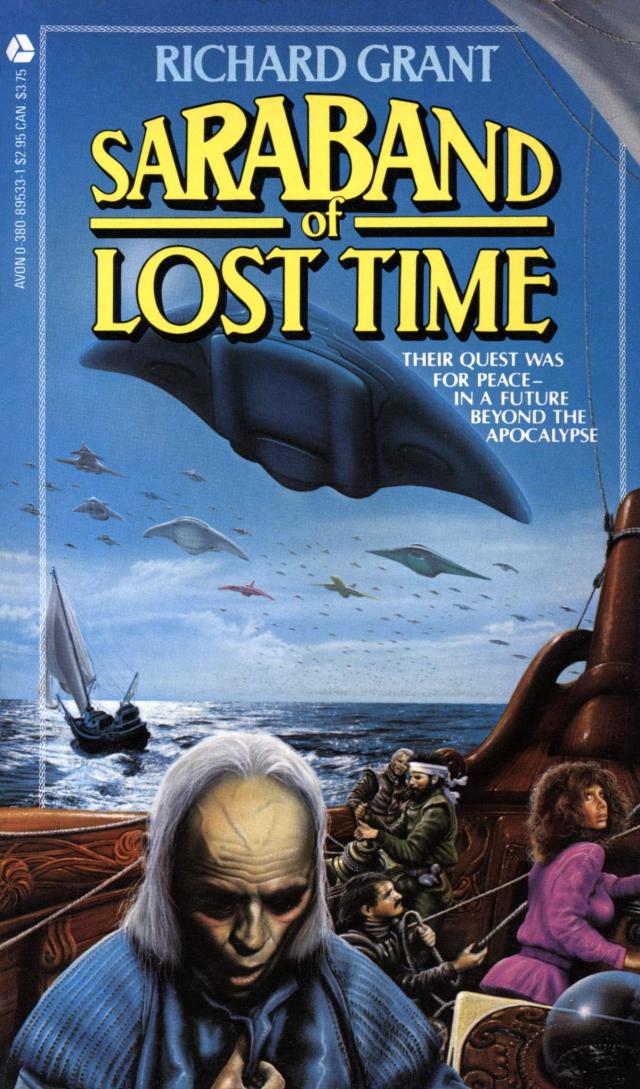
Saraband of lost time, p.5
Saraband of Lost Time, page 5


“Believe what?”
“You know, freedom and self-government and sharing the land. The stuff they say they’re fighting for.” Wicca turned her head; she had lost interest in the conversation. “Why don’t we sit someplace more comfortable?”
Puzzled, his mood broken, Brass helped her to an unsteady couch covered with a thin cushion. It did not seem particularly comfortable at first. Then Wicca settled herself against him, resting her head lightly on his shoulder and surrounding one of his heavy arms with both of hers. Slowly Brass began to understand.
That slowness, and the gentle hesitancy that followed, were rare things in Wicca’s experience. She savored them, as she had savored the sweetness of the sack, while in the depths of her mind a silent prayer recited itself: a prayer that nothing would happen to snatch this away, that at last she had found a place to rest.
As for Brass, he hardly thought at all. If there was anything whatever in his mind, as he lay beside his accidental lover, it was probably disbelief.
Dawn found the couple twined on the narrow couch, so deeply locked in something ineffable that ordinary things, when they woke to perceive them, took on a new and unsettling demeanor.
6. Taking Sides
The frames of the Warmaster’s derelict headquarters in the East were astir with rumors of distant shelling.
“I had a message from Sergeant Brass, my lord,” said Sinaq.
“Brass? Oh, yes.” The Warmaster was obviously distracted. He sat at a shattered window, breathing the wafture of death off the ravaged moor.
“He says that the Gray Market in St. Boto is in need of a thorough overhaul. All the good stuff is going to the King. Brass still doesn’t know his old lieutenant is about to show up. Oh, that will be a scene!”
The edge of the Warmaster’s new moustache twitched somewhat.
“He also reports, my lord, that there may be trouble with the local squire. The squire seems to be in league with the guerrillas somehow.”
“One assumes,” said the Warmaster, ignoring all this, “your friend will be making periodic visits to Lord Inbote.”
Inbote! thought Sirraq. This obsession with Inbote was becoming unhealthy; after all, there was a war going on.
The Warmaster inquired after the King.
“He hanged a few barristers yesterday,” Sirraq reported.
“Tomorrow he plans to bum fumigants in the Market, to celebrate the harvest and kill fishflies.”
The Warmaster spat. He declared that for all it was to him, the Easterners could keep their vile territory. “Look at it!” he demanded. “It is a wasteland. It is poisoned with foul salts. Inbote told me so, years ago.”
Sirraq shook his head. Things were greatly askew if bloody engagements did not cleanse his lordship’s mind. Something must be done.
Through the two walls separating the shambling cottage from the garrison house, Wicca could hear Brass on an unusually energetic rampage.
“You tail-draggers,” he declared, “are as rotten as week-old fish. It’s no wonder the Kingdom gets no respect from these people, with you the only thing they’ve got to look at.”
Wicca would have enjoyed the spectacle of his thick arms swinging wildly, inches before the noses of terrified underlings.
“Now this building,” Brass remarked, gracing its floor with a dollop of sacramental spit, “is not fit for the bastards of clapped-up whores. I myself could not sleep here if I had been awake for seven months.”
But even as the air of the room darkened with the violence of his address, Brass was conscious of a hollowness in the words. Well, autumn was a season for unusual moods. This one would pass.
“I am truly amazed,” he said, approaching the climax of his performance, “that the new officer is going to see you slime-drinkers looking like this. I shudder—I shudder—to think what he will do. If I were you, I would—”
But his advice was forestalled by the dreaded event he had just prophesized. Lieutenant-major Hadron strolled amicably through the door.
“Good morning, men,” he said.
Brass turned. “Holy mother of headaches,” he muttered.
Behind him, the small contingent of royal warriors trembled so rigidly in postures of extreme respect that it was a matter of moments before someone fainted.
Hadron’s face broke into an unseasonable grin.
“Why, Brass!” he exclaimed. “What a splendid surprise! I had no idea…”
He extended his hand in an almost brotherly greeting, and Brass—his mind swept clean by disappointment—accepted it. This conciliation made, he puffed himself back up.
“Lieutenant Hadron,” he rumbled, “I present the members of your garrison—as fine a team of seasoned troops as I have ever encountered in my extensive career.”
“Oh,” said Hadron, somewhat taken aback. Never having assumed command of a body of warriors before, he was uncertain what might be expected of him. Perhaps a few appropriate remarks?
Brass decided to get the lieutenant outside before he ruined everything.
“Sir,” he said, “may I request the privilege of a word with you in private?”
Hadron agreed readily, happy to escape the stiflingly military atmosphere of the garrison house. On the porch, the two men regarded one another, each struggling to insert this surprising development into his private set of intentions.
“It is good to have you here, Brass,” said the lieutenant, with unmistakeable sincerity. “This is my first command, you know, and I was a bit worried…”
Brass’s face turned up to form something like a tortured smile.
Hadron continued, “I spent much of the night studying charts of the valley. It really seems we are in a delicate position here. I would certainly be grateful for any suggestions you might…”
Brass nodded. Actually, he thought, things could be worse. It could have been some bullheaded careerist with ideas of his own.
“Lieutenant,” he said, “I’m always glad to help. In fact, I’ve got a few ideas we might discuss over an ale at the inn. At your convenience, of course.”
Hadron’s face was aglow with relief. “Yes,” he said, “that will be excellent. Perhaps one day next week. Nothing is likely to happen in the next few days is it?”
“Attack!” said Falspur, the eldest son of the squire. His outburst was absorbed by the thick oaken walls and cluttered furnishings of his father’s study.
The squire frowned.
“Why attack at a time like this?” demanded Cundiff, the black-skinned town reeve. “The new officer just got here from the Kingdom. Give him a chance.”
“But this is the perfect time,” said Falspur. His eyes flashed with intensity. “Catch him off his guard. Let him know his well-being depends on cooperation.”
“I think,” said Teapoy, landlord of the inn, “he may know that already. He spent the better part of the night in his room studying charts of the valley.”
The squire laughed. “Ah, my minister of intelligence. Peeping at keyholes again, are you?”
Teapoy bucked up his slight frame in a show of dignity. “I’ve no need for keyhole-gazing. Rugo sold me an eyebox and a raster-screen.”
Rugo beamed. He was the town’s leading trader and his prosperity was evident in his girth. “The new sergeant bought some, too,” he boasted.
“That was foolish,” said Falspur curtly. “Soon you’ll be selling them the rope that hangs us.”
Lord Emo, chief landholder of St. Boto and the surrounding valley, lord of the Kingdom by decree of Scaeigh’s predecessor, looked around at what passed for a town council. He was fond of them all, though he would have been hard put to say which of them gave him the greater unease. Probably it was Falspur.
“There’s no sense,” Rugo said, thoughtfully rubbing his belly, “in not being civil. We’ve been doing quite well in our trade with them. Who else could buy all our crops, or sell us modem equipment?”
“Rugo’s right,” said Teapoy.
“Modem equipment!” spat Falspur. “They refuse to sell us heatguns, or airboats, or voiceboxes, or anything else we could use against them.”
“One can hardly blame them for that,” said Cundiff. His dark countenance and wrinkled brow gave him a look of immense dignity.
“My point,” said Falspur irritably, “is that we must act quickly or give up our independence forever.”
Emo wished his son would behave more decently. “There is nothing to be gained,” he said, “by irritating the King’s emissary.”
“Then what, father, do you propose to do?”
Emo smiled. His dark eyes and thick black hair were the mold of Falspur’s, but his sharp features were softened into comfortable creases, and his heavy beard was woven white-on-black like rich tweed.
“I propose,” he said, “to invite him to lunch.”
Falspur was so flabbergasted he fell silent.
“Splendid idea!” said Rugo. He leaned back in his chair, testing its joinings.
“Keep him comfortable at the inn,” Emo told Teapoy. “And send me the bill.”
The little landlord nodded happily.
“Is there anything else, then?” Emo spread his arms, inviting new business and otherwise signalling an end to the meeting.
Falspur stalked out in conspicuous indignation. Cundiff lingered behind as Rugo and Teapoy bid the squire good-day. He made certain the door was tightly shut.
“Well, Cundiff,” said the squire. “How are our friends in the hills?”
“Foaming at the mouth as usual.” Cundiff faced Lord Emo across the expanse of his desk. “More weapons, more money, more action. They say they’re not a bunch of sheep farmers. They say if they had the right equipment they could shoot down an airfreighter, they’ve got the schedule all worked out.” Emo’s face was impassive. “Brandy?”
“No, thank you. Emo, if I were you I would throw them some kind of bone.”
“You would?”
“Just something symbolic. Let them knife a warrior on the way home from the tavern.”
“My, your tune changes with the accompaniment.”
“I’m just being realistic. You don’t know how impatient they get, grousing around out there.”
Emo stood and paced a bit. “If they step the least bit out of line we cut off their supplies. Do they realize that?”
“I’ve told them. They say they don’t care.”
“They will care enough if it happens.”
“But this is what I’m telling you, Emo. They really don’t care. They’re becoming quite dangerous.”
“All right.” Emo poured himself a slug of brandy. “Do this. Let them attack a shipment of some kind, something trivial. Fruit. And have them do it quickly. I want the attack to come before I have lunch with the new lieutenant.”
Cundiff was bemused. “What are you doing, Emo?”
Emo shot the brandy. “Just putting on a show. Get in touch when things are set up. And give my love to Alisha.”
Cundiff returned home that evening, drained and worried after meeting with the people of the woods, to find his daughter Alisha entertaining Sahm, the young juggler from the Porridge and Flagon. Sahm had left a hunting-gun propped inside the door. Cundiff examined the weapon coldly before turning into the sitting room.
Alisha was a full-fleshed young woman with wide, glowing eyes and the light brown skin of her dead mother. Her expression and all her features were gentle, even languid. Cundiff felt a trifle daunted in her presence.
“Hello, father,” she said in a voice that was quiet without timidity.
Cundiff looked at Sahm, who shifted edgily on the couch.
“So,” said the reeve, “you bring your weapon into town, begging for trouble, while your people go hungry in the hills.”
“We won’t be hungry long,” said Sahm.
“Oh? What do you plan to do, rob townspeople at gunpoint?”
Slowly Sahm stood up, stretching like a cat after a nap. “That’s not for you to know, reeve,” he said with a slanting smile. “You’re just Emo’s hired mouthpiece.”
This did not anger Cundiff as much as one might have thought. He had known Sahm since his trouble-prone childhood, and Sahm’s father before that. On the whole he had been glad when the young man took to the woods.
He said, “A new officer just arrived from the Kingdom, Sahm. He looks almost as young as you are. If you make trouble for him, he’s going to do exactly what you would do—he’s going to try to get even. Except you will be up in the hills, where he can’t find you. So he will take it out on St. Boto.”
“You talk like an old woman,” Sahm said angrily. “Always afraid to move, afraid to fight. If you were a man, you’d join us.”
He held Cundiff’s stare for a long moment, then brushed past him, snatched up the hunting-gun and slammed out the door.
Alisha went to her father and touched his shoulder.
“I’m sorry,” she said, “I shouldn’t have let him in. He has no right to talk to you like that.”
Cundiff pulled away in an unexpected show of agitation.
“Yes he does,” the reeve said. “He does, and he’s probably right.”
“No, father.”
“Yes!” Cundiff made an effort to calm himself and looked steadily at his daughter. He said, “Alisha, 1 want you to stay with Emo for a few days. I’ve already mentioned it to him. You know Lady Illandra will be happy to have you.”
Alisha’s wide eyes became even wider. “Father, what is it?”
“I don’t know,” he said. “I really don’t. But go on and get some things together. I want you to go in the morning.”
7. Cheeve Arbor
Brass was only too happy to accept Lieutenant Hadron’s invitation, a week after their first encounter, to breakfast at the Porridge and Flagon. Any arrangement that kept the young officer away from the garrison had much to commend it.
“You seem comfortable here, sir,” said Brass hopefully.
“Yes, I am, thank you. How are you getting along?”
Brass was quite comfortable himself. “Oh, tolerably,” he allowed.
But the main topic of breakfast conversation was Hadron’s novel theory that the guerrillas were somehow involved in the wool trade.
“I flew a good distance over the hills yesterday,” he confided, “and finally I came to a pasture where there were a great many sheep. Well, the shepherd was a young fellow, dressed all in leather, and when I flew over, he lifted a hunting-gun and shot at me. Can you imagine? Now, who would shoot at an airskiff?”
Brass had no idea.
“What I’ve got to do,” Hadron whispered, “is renegotiate our treaty, so that the squire agrees to take more aggressive action against the guerrillas.” He kept quiet because a rowdy contingent of Emo’s militia occupied two tables across the room. Their guns were propped against the wall.
This kind of talk worried Brass. He poured syrup on his cakes and mashed a blood sausage, letting it run over the plate. There was strength in good eating.
A violent pounding came at the door. Something was being laid over the entrance, and a clamor was up in the street.
“Great waggers,” one of Emo’s men got out, coughing up curds.
The militiamen brushed aside food, seized weapons, and made a disorganized rush at the door. Brass held back, his heatgun in his belt. Hadron was unarmed.
“They’ve blocked the door!” shouted an ill-clothed man.
“Who?” said Hadron.
“Shoot it down!”
“No!” cried Teapoy, who raced across the room brushing gun barrels aside. “Wait! Try the back!”
Brass took a last gulp of sausage, chased it with milk, and crossed the room. “Get out of the way,” he told Teapoy.
“What are you doing?” the landlord demanded.
Brass leveled his heatgun. The thick door exploded; flaming bits of wood flew at mad angles. Brass stepped through the hole.
A large bullet struck the wall beside him, chipping stone from the tavern’s facade. Brass ducked, rolled into the street, and fired blindly. Whoever had shot at him was out of sight. He planted his feet in the center of the roadway, laying claim to the town. He could hear Emo’s militia shouting behind the tavern.
“What is going on?” said Hadron, appearing in the smoldering doorway.
Brass’s eye was caught by a furtive movement in the direction of the garrison, where shadows moved behind the hedges. He began running up the street.
“Wait!” yelled Hadron, twenty paces back.
“Damn it, lieutenant,” he shouted back, “get a weapon!”
Hadron came on anyway.
Brass reached the overgrown alley leading to the cottage and garrison. He moved stealthily, keeping behind clumps of mulberry. Just outside the courtyard the wall exploded and pieces of brick rained on his head.
Brass had not expected it to start so soon. He leapt into the courtyard and fired twice at the first shape that seemed out of place. He blinked at the screaming.
One of the bodies on the cobbled ground had been the slouching young guard. The other was that of a leather-clad guerrilla, slightly paler of complexion than the reeve Cundiff. Brass pounded at the door of the cottage.
“Open that door and I’ll kill you, you bastard!” came Wicca’s voice.
Brass relaxed, left the barricade in place and turned to verify that the footfalls down the alley were Hadron’s.
The lieutenant bent to examine the corpses. Emo’s men shouted in the street. Brass slipped through the cedars to the garrison house itself, where a second royal warrior—this one seventeen at most—lay on the porch with his throat slit.
The door of the garrison, too, was boarded shut. He kicked it. “Are you titmice in there?”
“It’s the sergeant,” he heard through the planks.
From the side of the house came a clatter, as if one of the warriors had jumped out a window.
“Get out here, suckling,” Brass rumbled. He imagined the sheepish expression, the stammering explanation that would greet him, imagined them so strongly that he was utterly immobile when a long-legged guerrilla stepped smartly around the corner and confronted him with a shotgun.