Saraband of lost time, p.1
Saraband of Lost Time, page 1


09-02-2023 - Converted from a scan
INTO THE OVERMIND
Inbote stood alone in great brightness. His eyes were restored, and focused on the immense doors before him. Slowly he walked toward them, wondering at the shining that came through the tiny space beneath. As he drew nearer he saw that their surfaces were composed of purest diamond, black with the emptiness of the void, in which all Essence is born and annihilated each moment…
Avon Books are available at special quantity discounts for bulk purchases for sales promotions, premiums, fund raising or educational use. Special books, or book excerpts, can also be created to fit specific needs.
For details write or telephone the office of the Director of Special Markets, Avon Books, Dept. FP, 1790 Broadway, New York, New York 10019, 212-399-1357. IN CANADA: Director of Special Sales, Avon Books of Canada, Suite 210, 2061 McCowan Rd., Scarborough, Ontario MIS 3Y6, 416-293-9404.
AVON
PUBLISHERS PF BARD, CAMELOT, DISCUS AND FLARE BOOKS
Contents:-
1. Meek’s Gaff
2. Riverrun
3. Fall from the Summit
4. Maneuvers
5. St. Boto
6. Taking Sides
7. Cheeve Arbor
8. Autumn Heat
9. Casualties
10. Dark Spirits Arise
11. A Shuffle of Futures
12. The Ghoulmire
13. The Metal Empire
14. Fire and Water
15. A Last Claret in the Ghoulmire
16. Spring Chill
17. Midnight Wastes
18. Voices
19. The Halflife Estuary
20. Seastaithe
21. The Whole Realm
22. Blackfell
23. The Hunt
24. The Seer
25. A Sympathy for Machines
26. The Nigredo
27. Solarmill Cluff
28. The Warmaster’s Sonnet
29, Storming the Threshold
30. The Secret Garden
31. Penetrations
32. Through the Diamond Doors
33. Rowan’s Tale
34. Till Both at Once Do Fade
35. Saraband of Lost Time
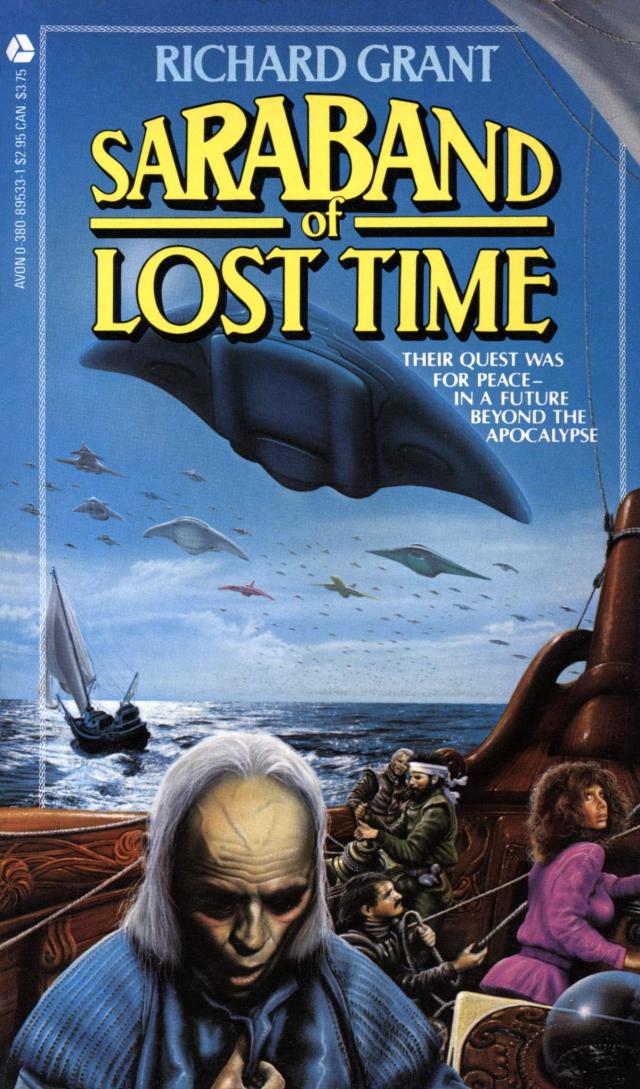
SARABAND OF LOST TIME is an original publication of
Avon Books. This work has never before appeared in book form. This work is a novel. Any similarity to actual persons or events is purely coincidental.
AVON BOOKS
A division of
The Hearst Corporation
1790 Broadway
New York, New York 10019
Copyright © 1985 by Richard Grant
Published by arrangement with the author
Library of Congress Catalog Card Number: 84-91233
ISBN: 0-380-89533-1
All rights reserved, which includes the right to reproduce this book or portions thereof in any form whatsoever except as provided by the U.S. Copyright Law.
For information address Richard Curtis Associates, Inc.,
164 East 64th Street, New York, New York 10021
First Avon Printing, March, 1985
AVON TRADEMARK REG. U.S. PAT. OFF. AND IN
OTHER COUNTRIES, MARCA REGISTRADA, HECHO
EN U.S.A.
Printed in the U.S.A.
10 9 8 7 6 5 4 3 2 1
Antonio, I believe in everything.
—Frederick Buechner, The Book of Bebb
1. Meek’s Gaff
in the old stone tower of Meek’s Gaff, a squalid northern village, the great clock ticked for the first time in five hundred years. Its hands were long gone, melted for slugs or arrowheads, and its inner workings were inhabited by a family of owls. One of these birds, reacting to the tick perhaps or the strange perturbation of the air that caused it, flapped out into the chill gray morning, became frightened by something in the sky, and tumbled to a shaky perch in the upper branches of an apple tree. The clock ticked twice.
Wicca, the cripple, out since daybreak gathering eggs before the boys from the hills could get them, emerged from her coop and noticed the owl.
“Don’t you know what time it is?” she said.
The owl cooed.
“Oh,” said Wicca. “All right.”
If it was an omen she would ignore it. Hanging the egg basket on the bow of her crutch, she turned to her rundown cabin, little better than the coop, and would have entered had not the owl cooed again. Something was bothering it. She pivoted on her crutch like a one-toothed gear and stared first at the owl, then at the thing in the sky.
Alien, black bellied, it floated like an unnatural cloud. Wicca strained her ears and eyes, both sets sharp, but could not tell what feat of enchantment or engineering kept it hanging there. She might have thought, the air feels differently, but this was a subliminal notion, much less pressing than the need to reach the tower and ring the great chimes. Waking the village would do no good, of course. But the chimes would disturb the boys in the hills, and they would come down with all their guns. They owe us that, at least, thought Wicca.
Brushing the shawl from her eyes where it had fallen in her agitation, she hobbled through the weeds and onto the road, making for the tower. The egg basket bobbled at her side. It didn’t look like the sun was ever coming out, but this was September and life was almost gone from Meek’s Gaff. Certainly no life stirred in the rubbly shells that passed for homes. Wicca was out of breath when she reached the tower and circled around to the door.
She gasped.
The black-clad man was surely as surprised as she, but he moved faster. Wicca realized as he raised his weapon—an ugly thing, all twisty and squat—that he was only a boy, no older than the boys in the hills. But what counted now was the tiny muzzle aimed at her face, the twitching fingers and wide, frightened eyes. She had seen the look before.
“Get your ass out of my way,” she said, on the theory that cursing calms soldiers. “I’m taking these eggs to the terrible wizard that lives in this tower, and if he doesn’t get them he’ll—”
The soldier, the frightened boy, did something with his weapon that made a click and came a step closer. Okay, thought Wicca, he isn’t going to shoot.
“Who are you?” she said.
“A royal warrior,” the boy said proudly. “You’re my prisoner. Put the basket down, please.”
His accent was strange, like a traveling thief, or a southerner. The rope that rings the clock-chimes was only ten feet away.
She reasoned with him. “I’ve got to take these eggs inside. Then I’ll be your prisoner.”
She moved her crutch toward the door and took a step behind it. The soldier hesitated, then shouldered his gun.
“Here,” he said, “I’ll carry them for you.”
It was perfect. Wicca hit him in the eye with a big brown egg and had the gun out of her dress before he could sputter the yolk away from his mouth. His eyes were so wide Wicca wondered remotely whether the lids were jammed in the sockets.
“Just keep still and I won’t hurt you,” she said. “Put your gun…”
Feet clomped nearby—heavy-booted feet, not the feet of a villager or a guerrilla. The boy’s terror was mingled with relief; he glanced sideways and quickly back again, holding Wicca locked in those wide blue eyes as if it were the power of his attention that kept her from firing. The footsteps grew louder.
Around the corner came a second warrior, a little older, tougher looking, hefting his weapon with authority. Wicca knew this type, too. She gave him one chance to be smart and put his hands up, then she killed him. The crash of the pistol echoed off the walls, off the distant hills. No need to ring the bells now. The boy looked ready to cry.
“Get out of here,” said Wicca as cruelly as she could. “Move!”
The boy ran off like a bushrabbit. He had never gotten around to dropping his gun.
Sergeant Brass rumbled through a pitiful little vineyard (wizened plants, brown induviate leaves—and it was only September) when he heard the first gunshot. Reflexively he dropped into a crouch, studying without attention the bark of a century-old oak, and listened. He heard only the squawk of scared birds and the visceral shudder of the airketch, thrusting columns of hot exhaust into the cold air.
It’s started early, Brass thought. He sighed and tapped the mouthphone, a venerable gadget which responded with a series of growls and an electrical hiss. Nothing worked right anymore.
For interminable minutes Brass crept through alleyways, pressing himself into blown-out niches where the stone smelled of cold urine. He saw no one, raider or resident, though he heard a flutter of footsteps and voices pitched down to children:
Keep low.
Then more shooting began. Craning over a low wall Brass could see puffs of smoke from a thick stand of scrub-pine. He raised his weapon and squeezed its firing pin. The missile sputtered away, towing a train of feeble sparks like an exhausted comet. Somewhere ahead it exploded with a deep dry THOOMF. Before he could reload, footsteps sounded behind him. Brass spun around.
It was a young raider. The boy saw Brass and opened his mouth to speak, but nothing came out. He was plainly terrified. There was also something yellow smeared over his face.
Brass said, “What’s all that racket? Who’s doing the shooting?”
The boy had not gotten it out when a sound too immediate to hear knocked the two of them off their feet and splattered them with cold dirt. The boy made a quiet little whimper. Brass scrabbled across the yard and dragged the young warrior to his feet, meaning to shout some courage into him, but the boy was dead. The scrawny body in Brass’s arms was too light, like something not yet finished.
“Fry me in pig fat,” said Brass.
“What?” cried a small electric voice in his ear. “Is that you, sergeant?”
Brass laid the boy down.
“Where are you bogtrotters?” he shouted. “We’ve landed in a nest of guerrillas down here.”
“That’s impossible,” said the clipped-off voice of the pilot. “There are no guerrillas this far north.”
The alley echoed with an antiphony of field-guns.
“It must be my mistake, then,” said Brass testily. His words were lost in a snarl of static. Brass stuffed the communicator into his tunic.
The way was clear to the old tower. Brass covered the distance in thirty pumps of his short, heavy legs. He paused a moment to study the black-clad body on the ground and then fired his weapon; the missile turned upward like a deranged skyrocket, pirouetted crazily and almost struck the airketch. Brass chuckled, took a deep breath, and stormed the tower door.
The place was dark and empty and smelled of owls. From the headpiece in his pocket came the pilot’s voice, muttering something unintelligible. It might have been “We’re coming down,” but then it might have been something else entirely. A shell landed just outside the door, blowing pieces of the porch into the room. High overhead the clock-chimes reverberated in sympathy. As Brass listened, the hum of chimes faded into another sound more complex, less mellifluous.
The airketch.
Heedlessly he stuck his head out the door. The fluted* asymmetrical wings seemed to grow wider as the airketch made a ponderous descent. From somewhere on its ventral surface a heat-cannon penetrated the smoke with its pale* violet beam. A fountain of Fire gushed from the ruins. The airketch settled with a metallic crunch* twenty feet from the tower, and an unlikely figure stepped out.
Stupidly splendid in his scarlet tunic* Lieutenant-minor Hadron stood in the ravaged street.
The ostinado of gunfire* which had diminished with the arrival of the airketch, swelled again. Brass heard the whistle of an incoming shell in time to duck, but the lieutenant was standing fully upright when the street erupted behind him. He vanished in a cloud of dust and smoke.
Brass could have cried. The death of a superior officer was one of the truly horrible nightmares of a military career. No one ever wanted to believe it was the officer’s own fault—and Brass hated paperwork. He crawled into the smoke, praying for a miracle but holding out little hope.
A breeze cleared the air. Before him, inspecting his shredded tunic, stood the lieutenant. He saw Brass clawing through the rubble and smiled.
“One can only be thankful,” he said, “for underarmor.”
Brass stood up. He said, “We’ve got to get out of here.”
Lieutenant Hadron ignored him. He was a young man, tall and red cheeked, of a physical type generally agreed to be handsome, though to Brass’s eye there was something too fixed, too unmoving, about the officer’s expression, as if he had locked his firm jaw years ago and not budged it since. Brass himself—short, thick limbed, unimposing—liked to remain flexible.
Hadron gave the tower an appraising eye. He said, “This seems like the sort of place we’re looking for. I’m going to have a glance inside.”
“But lieutenant,” Brass sputtered. “There’s nothing there. And we’re surrounded.”
As if to prove his point, a near-miss battered their eardrums.
“Perhaps you missed something,” said Hadron. “I won’t be long.”
He turned and strolled to the door, passing as if by divine grace through a shower of bullets.
For lack of a more cogent recourse, Brass fired his weapon. This time the missile jammed in the launcher, spuming fire and showering Brass with sparks. Terrified, he hurled it away with all his might. It exploded near the tower, opening a wide crack in the ancient wall.
To a warrior cowering near the airketch he bellowed: “You there! Climb up in that tower and keep a sniper watch.”
The warrior stared back in disbelief.
In short order Lieutenant Hadron discovered a staircase leading to some kind of cellar. It was very dark, but at least the air was breathable. Which way to go?
As Hadron committed himself to one direction there was a scuffling from the other. He spun, blinked in the darkness, and should have fired. Instead he lowered his weapon. His eyes focused on a woman of indeterminate age, bent over a crutch and holding an extremely large gun.
“Stupid bastard,” she said. “Why didn’t you shoot me?” Hadron wondered about this himself. He said, “Because I am not your enemy, my lady.”
“Ha!” said the woman, but without conviction. She slumped a bit on her crutch.
Outside there was some sort of clamor.
“Listen,” said Hadron rapidly, “I only want to have a look around the building here. Then I will go. What I’m looking for, you see, is anything particularly ancient or inexplicable. Machines, weapons, artwork…I’m sure you know the sort of thing.”
The woman glared at him. She was not so old or unattractive as she had looked at first glance. A bit unwashed, certainly. She said, “You won’t find any of those things here.”
“Oh? Where might I find them, then?”
The woman betrayed herself by not lying quickly enough. Hadron held out his hand as an explosion shook the building.
“Please, my lady. We can help you…the surgeons back at the Capital can do remarkable things…you may be able to walk again…please, my lady.”
Brass’s voice rattled down the stairwell. “By God, lieutenant, you better come out of there fast! We’re about to be overrun!”
“Hold on a few more moments,” Hadron called back. Ignoring the woman’s gun, he brushed past her and moved down the hallway.
“Wait!” she cried. “It’s in here.”
She touched a spot on the wall. A panel slid back to reveal a gaping cavity. Smells of mustiness and engine oil drifted out. The woman turned on a light.
In the pale blue glow was an enormous cache of antiquities. Books and boxes and sleek machines were piled to the ceiling, as if all the valued stuff of the village had been collected here for safe storage. There were also a good number of weapons and a rack of clothing. Hadron entered gleefully.
Brass raged down the stairs. “We’re going to be baked alive, lieutenant, if we don’t—”
The woman’s gun was leveled smartly at his forehead.
“Oxballs,” he said.
Hadron stuck his head out of the storeroom. “My lady,” he said, “would you please not point your weapon at the sergeant? Thank you. Brass, it’s a veritable warehouse in here.”
He disappeared again.
Brass exhaled. “Who are you?” he demanded of the woman.
She seized his arm. “Take me out of here. Quickly. He promised.”
The old building quivered in its footings. Hadron, still oblivious, stepped into the hall. “What do you make of this?” he said.
He carried a small box in which were displayed two large, black gems.
Brass could not put words to his exasperation. He used all four limbs getting up the stairs.
“Look alive, bogtrotters!” he cried to the terrified young warriors huddled beneath the windows. Their terror increased.
It was going to be a tough morning’s work.
2. Riverrun